
There are 1.4 billion adults in the world who don't have a bank account. No savings account. No credit card. No way to send money internationally without paying predatory fees. No access to loans unless they go through informal lenders charging punishing interest rates.
This isn't a niche problem. It's one of the largest barriers to economic participation on the planet — and it exists not because these people lack money or ambition, but because the traditional banking system was never built for them.
DeFi was.
Not intentionally, not by design from the start — but by consequence of what decentralized finance fundamentally is: an open, permissionless financial system that requires nothing more than a smartphone and an internet connection to access. No credit history. No government ID. No minimum balance. No branch office within driving distance.This is the quiet revolution happening beneath the headlines about token prices and yield strategies. DeFi is rebuilding financial infrastructure from scratch — and for the first time in history, that infrastructure is available to everyone.
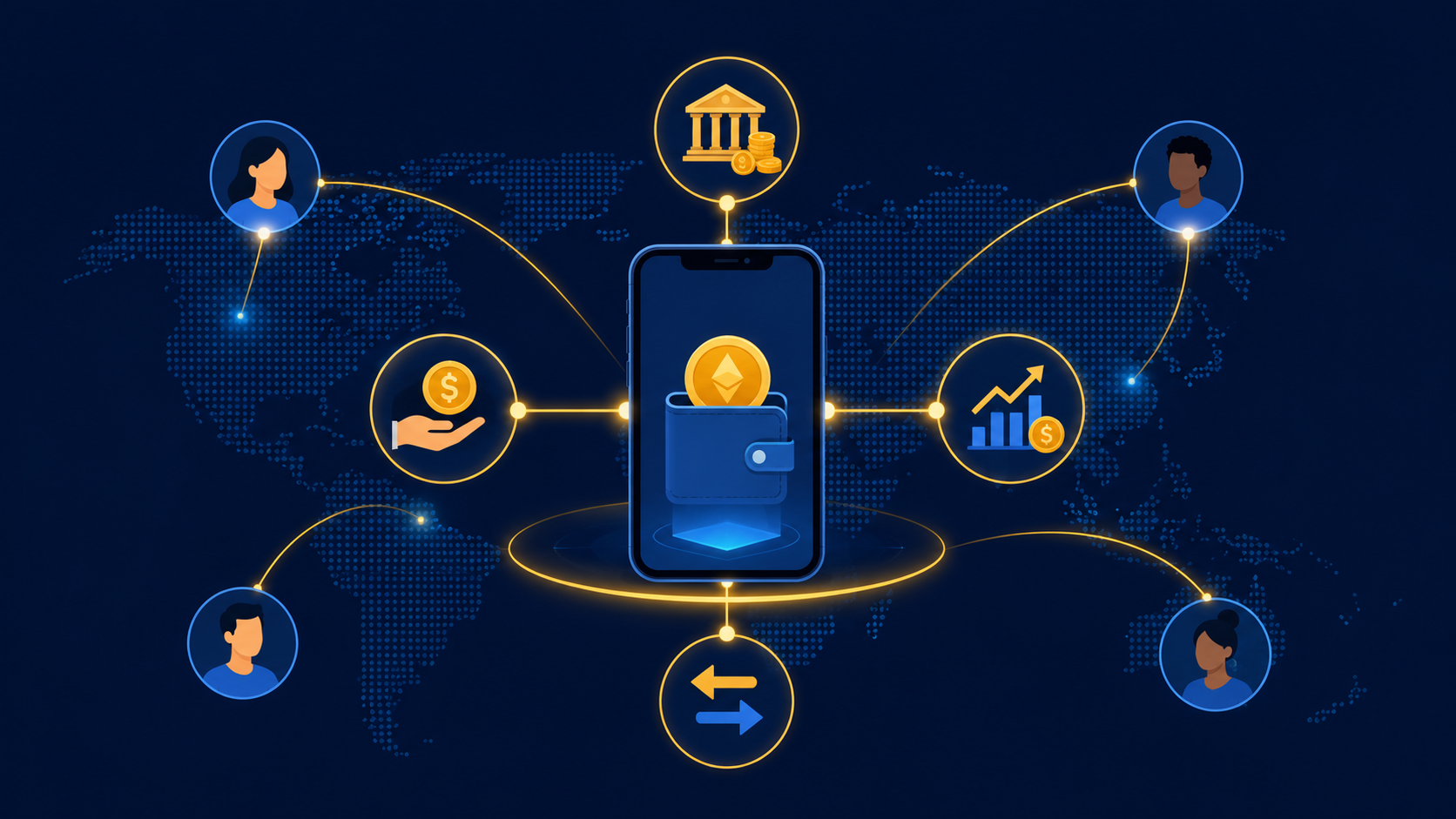
Before understanding how DeFi helps, it’s worth being specific about who we’re talking about.
The unbanked aren’t a monolithic group. They include subsistence farmers in rural sub-Saharan Africa who have never lived within 50 miles of a bank branch. They include migrant workers in Southeast Asia who send remittances home to families but lose 8–10% of every transfer to fees. They include entrepreneurs in Latin America who can’t access business credit because they lack formal employment history. They include women in regions where cultural or legal barriers prevent them from opening accounts in their own names.
What these groups share is exclusion — not from the desire to participate in the financial system, but from the system itself. Traditional banking has physical requirements, documentation requirements, minimum balance requirements, and geographic requirements that billions of people simply cannot meet.
The World Bank estimates that two thirds of unbanked adults own a mobile phone. The infrastructure for financial inclusion already exists in their pockets. What was missing was a financial system that could run on it.
No account required — just a wallet
Opening a bank account in the developed world feels routine. In much of the developing world it requires government-issued photo ID, proof of address, minimum opening deposits, and physical presence at a branch — barriers that eliminate a significant portion of the population before the conversation even starts.
Creating a crypto wallet requires none of that. Download an app, generate a wallet, and you have a fully functional financial address in under two minutes — capable of receiving, storing, and sending value anywhere in the world. The wallet doesn’t know your name, your nationality, your income, or your credit history. It just works.
As we covered in our Crypto Wallet Safety guide, that simplicity comes with responsibility — self-custody means no one can recover your funds if you lose access. But for someone who has never had access to financial services at all, that tradeoff looks very different than it does to someone choosing between DeFi and a Chase checking account.
Borderless value transfer
Remittances — money sent by workers back to families in their home countries — represent one of the largest financial flows in the global economy. In 2023, remittances to low and middle income countries totaled over $650 billion. The average cost of sending that money through traditional channels runs around 6–7% of the transfer amount.
On a $300 monthly remittance, that’s $18–21 lost to fees every single month. Over a year, that’s $216–$252 that could have gone to food, education, or savings instead of wire transfer fees.
Sending stablecoins on a Layer 2 network costs a few cents and settles in seconds. The recipient needs only a wallet address to receive it. No SWIFT codes. No correspondent banking fees. No three-day settlement windows. No questions asked.
For the families receiving remittances, this difference is not abstract — it’s groceries, school fees, and medical care that were previously eaten by the financial system.
Access to yield that was previously unavailable
In developed economies, earning steady yield on savings is straightforward — Treasury bills, money market funds, high-yield savings accounts. In much of the developing world, these options either don’t exist or are accessible only to the wealthy. Informal savings groups, cash under mattresses, and low-interest local accounts are the realistic alternatives.
DeFi lending protocols offer the same yield opportunities to a farmer in Nigeria as to a fund manager in New York. Deposit stablecoins into Aave and earn the same interest rate as anyone else on the platform — regardless of your location, your income, or your relationship with a financial institution.
The yield isn’t guaranteed and the risks are real — as we covered in our DeFi Insurance guide and Risks of DeFi guide. But access to those opportunities at all is genuinely new for billions of people.
Borrowing without a credit score
Traditional credit is built on credit history — a record of past borrowing and repayment that proves you’re likely to repay future loans. If you’ve never had access to formal credit, you have no credit history. If you have no credit history, you can’t access credit. It’s a catch-22 that keeps people locked out of the formal economy indefinitely.
DeFi lending doesn’t use credit scores. It uses collateral. As we explained in our DeFi Lending & Borrowing guide, anyone with crypto assets can borrow against them on Aave or Compound — no application, no credit check, no relationship with a financial institution required.
For people with access to crypto but not to formal credit markets, this opens borrowing opportunities that simply didn’t exist before.
This isn’t purely theoretical. DeFi adoption in the developing world has been measurably accelerating — driven not by speculation but by genuine utility.
Venezuela has seen widespread crypto and stablecoin adoption as a response to hyperinflation that has devastated the local currency. With the bolivar losing value rapidly, Venezuelans have used stablecoins as a store of value and medium of exchange when the local financial system failed to provide either.
Nigeria consistently ranks among the highest countries for crypto adoption globally — not primarily as speculation but as a practical response to currency controls, limited banking access, and unreliable payment infrastructure. Peer-to-peer crypto trading has become a mainstream financial tool for millions.
The Philippines is home to one of the world’s largest communities of crypto users driven partly by remittance use cases. Overseas Filipino workers sending money home have increasingly turned to crypto rails to reduce the fees that traditional remittance services charge.
El Salvador made Bitcoin legal tender in 2021 — a controversial decision, but one explicitly motivated by the fact that 70% of the population was unbanked and remittances represented 24% of GDP. Whatever the outcome of the Bitcoin experiment specifically, the underlying problem it was trying to solve is real.
DeFi’s potential for financial inclusion is real — but so are the barriers that still stand between that potential and widespread reality.
Smartphone and internet access. While mobile penetration is growing rapidly in developing markets, reliable internet access remains unavailable or unaffordable in many of the regions where banking exclusion is most severe. DeFi requires connectivity — which means it can’t yet reach the most remote or underserved populations.
Volatility and complexity. Most DeFi activity involves assets that fluctuate in value — not ideal for people living paycheck to paycheck who need financial stability above all else. Stablecoins address this partially, but navigating DeFi safely still requires a level of financial and technical literacy that takes time to build.
Gas fees and transaction costs. On Ethereum mainnet, gas fees remain a barrier for small transactions. Layer 2 solutions have dramatically reduced this problem — as we covered in our Layer 2 Solutions guide — but the infrastructure for truly micro-scale financial inclusion is still maturing.
Self-custody risk. The same self-custody that makes DeFi permissionless also means there’s no safety net. Losing a seed phrase means losing everything. For populations without existing financial literacy infrastructure, this risk is significant.
Regulatory uncertainty. Governments in several developing markets have responded to crypto adoption with restrictions rather than frameworks — creating legal uncertainty for users and limiting mainstream adoption in some of the regions where DeFi could have the most impact.
DeFi wasn’t designed specifically to bank the unbanked. It was designed to create an open, permissionless financial system — and the consequence of that design is that it excludes no one.
That distinction matters. DeFi doesn’t require a mission statement about financial inclusion to deliver it. The inclusion is baked into the architecture: open source, permissionless, borderless, and running 24 hours a day on nothing more than internet access and a wallet.
The financial system that exists today was built for the people it serves — and for 150 years it has served the connected, the documented, and the wealthy better than anyone else. DeFi is the first financial infrastructure in history that has no structural preference for any of those characteristics.
Whether that potential is fully realized depends on the infrastructure challenges — connectivity, user experience, regulatory frameworks — that still need to be solved. But the foundation is there. And for 1.4 billion people who have never had access to a bank account, a foundation is exactly where everything starts.
Educational content only — not investment, financial, tax, or legal advice. Cryptocurrency and DeFi involve substantial risk, including the potential for total loss of capital. See our full Terms & Conditions and Privacy Policy.