DeFi Lending & Borrowing: How to Earn and Borrow Without a Bank
Your bank pays you 0.5% interest on your savings account. Meanwhile, DeFi lending protocols are offering 5%, 8%, even 12% — and they don't care who you are, where you live, or what your credit score looks like. All you need is a crypto wallet and an internet connection.
This is the promise of DeFi lending and borrowing: a fully open, automated financial system where anyone can step into the role of lender or borrower — no bank required, no paperwork, no waiting days for approval.
In this guide, you'll learn exactly how DeFi lending works, how to earn yield on your crypto, how to borrow against your assets without selling them, and what risks you need to understand before you put a single dollar in
.Let's get into it.
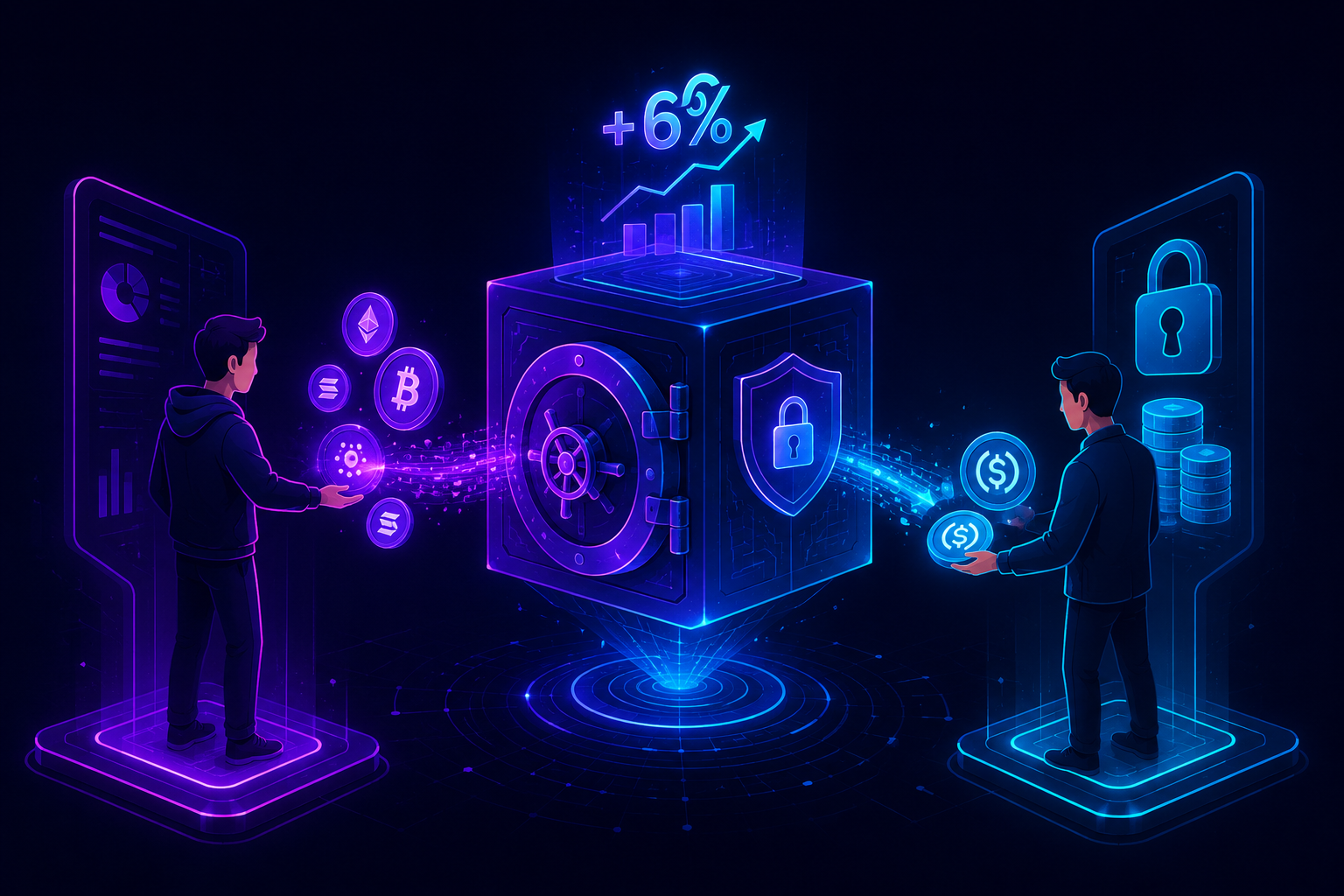
What Is DeFi Lending and Borrowing?
Before we dive into the mechanics, let's take a step back and understand why this exists in the first place.
In traditional finance, banks sit in the middle of every lending transaction. You deposit your money, they lend it to someone else at a higher interest rate, and they keep the difference. You might earn 0.5% on your savings while the bank charges the borrower 7–20%. That gap is the bank's profit — earned using your money.
DeFi (Decentralized Finance) eliminates the middleman entirely. Instead of a bank managing the process, smart contracts — self-executing pieces of code on the blockchain — handle everything automatically. Lenders deposit funds directly into a protocol, borrowers access those funds by putting up collateral, and interest is distributed automatically.
No bank. No loan officer. No credit check. No office hours.
The two key players in any DeFi lending system are:
- Lenders (also called Suppliers): People who deposit their crypto into the protocol to earn interest
- Borrowers: People who lock up crypto as collateral and borrow a different asset against it
Both parties interact entirely through smart contracts, which means the rules are transparent, the process is automated, and no one can change the terms mid-way through.
How DeFi Lending Works
Depositing and Earning Interest
When you lend on a DeFi protocol, you’re depositing your crypto into a shared liquidity pool. Think of it like a communal savings account that anyone can draw from — except instead of a bank managing it, a smart contract does.
Here’s what happens step by step:
- You connect your crypto wallet (like MetaMask) to a lending protocol like Aave or Compound
- You choose an asset to supply — for example, USDC, ETH, or DAI
- You deposit your tokens into the protocol’s smart contract
- In return, you receive interest-bearing tokens that represent your deposit. On Aave, these are called aTokens. On Compound, they’re called cTokens
- Your interest-bearing tokens automatically grow in value as interest accrues — no claiming, no staking, no action needed
The interest you earn comes from borrowers who pay to use your deposited funds. The more demand there is to borrow a particular asset, the higher the interest rate lenders earn.
How Interest Rates Are Determined
DeFi lending protocols don’t set fixed interest rates. Instead, rates are determined algorithmically based on supply and demand.
Here’s the logic: if a lot of people are borrowing an asset and the liquidity pool is nearly empty (high utilization), interest rates go up. This attracts more lenders to deposit and discourages more borrowing. When utilization is low — meaning plenty of funds are available — rates drop.
This means interest rates can change frequently, sometimes dramatically, depending on market conditions. On most platforms, you’ll see a current APY (Annual Percentage Yield) displayed, but that rate is variable and updates constantly.
Aave offers an additional option: a stable borrow rate, which stays fixed in the short term. It’s generally higher than the variable rate but gives borrowers more predictability — useful if you’re planning around a specific cost of borrowing.
How DeFi Borrowing Works
Overcollateralized Loans: Why You Put Up More Than You Take
DeFi borrowing works very differently from a traditional bank loan. There’s no credit check, no income verification, and no trust involved — because DeFi doesn’t need trust. It uses collateral instead.
To borrow in DeFi, you must first deposit collateral worth more than the amount you want to borrow. This is called overcollateralization.
Here’s a simple example:
- You deposit $1,500 worth of ETH as collateral
- The protocol lets you borrow up to $1,000 in USDC (a 66% Loan-to-Value ratio)
- You now have $1,000 in stablecoins to use however you like, while your ETH remains locked in the protocol
Why would you do this? Because you get liquidity without selling your ETH. If you believe ETH is going to increase in value, selling it would mean missing out on those gains — and triggering a taxable event. By borrowing against it instead, you keep your ETH exposure while still having cash to use.
This is one of the most powerful and practical use cases for DeFi lending: accessing liquidity from your crypto holdings without actually selling them.
The Health Factor: The Number You Must Watch
Every borrowing position in DeFi has a Health Factor — a number that tells you how safe your loan is.
The Health Factor is a ratio of your collateral value to your borrowed amount, adjusted for the specific liquidation thresholds set by the protocol. As long as your Health Factor stays above 1.0, your position is safe. If it falls below 1.0, your collateral gets liquidated.
Here’s how it can go wrong:
- You deposit $1,500 of ETH and borrow $1,000 in USDC
- The price of ETH drops significantly — say, 40%
- Your collateral is now worth $900, but your debt is still $1,000
- Your Health Factor drops below 1.0
- The protocol automatically sells a portion of your ETH collateral to repay the loan — this is liquidation
Liquidation protects lenders from losing money, but it’s painful for borrowers. You lose a chunk of your collateral, and some protocols charge a liquidation penalty on top of that.
The golden rule: never borrow the maximum amount. Always leave a healthy buffer between your collateral value and your loan. Most experienced DeFi users borrow only 30–50% of their maximum allowed amount.
Flash Loans: Borrow With Zero Collateral
There’s one type of DeFi loan that works completely differently: the flash loan.
Flash loans allow you to borrow any amount of funds with absolutely no collateral — with one condition: the loan must be repaid within the same blockchain transaction. If the funds aren’t returned by the end of the transaction, the entire thing is automatically reversed, as if it never happened.
This sounds strange, but it’s genuinely useful for advanced DeFi strategies like arbitrage (profiting from price differences across exchanges) or collateral swaps (switching your collateral type without closing your position).
Flash loans aren’t relevant for most beginners, but they’re a fascinating example of what’s possible when financial services run on programmable smart contracts.
The Bottom Line
DeFi lending is one of the most practical entry points into the world of decentralized finance — and once you understand how it works, it’s hard to go back to watching your savings earn next to nothing at a traditional bank.
Here’s what you need to remember:
- Lenders deposit crypto into a protocol and earn interest automatically — no action required after depositing
- Borrowers lock up collateral to access liquidity without selling their assets
- Overcollateralization protects the system — you always put up more than you borrow
- Your Health Factor is the number that keeps you safe — watch it closely if you borrow
- Flash loans are a powerful advanced tool, but not something beginners need to worry about
The mechanics are real. So are the risks. But so are the risks — smart contract vulnerabilities, liquidation, and volatile interest rates are all part of the picture.
Start small. Use stablecoins. Keep your Health Factor comfortable. And never deposit more than you’re willing to lose.
Educational content only — not investment, financial, tax, or legal advice. Cryptocurrency and DeFi involve substantial risk, including the potential for total loss of capital. See our full Terms & Conditions and Privacy Policy.