
If you've spent any time in crypto circles, you've heard both terms thrown around constantly. DeFi. CeFi. Sometimes in the same sentence, sometimes as opposites, sometimes as if they're interchangeable. They're not.
Understanding the difference between decentralized finance and centralized finance isn't just a vocabulary exercise. It's the foundation of every decision you make in crypto — where you store your assets, who you trust with them, what risks you're taking on, and what you're giving up in exchange for convenience.
Here's the honest, complete picture of both.
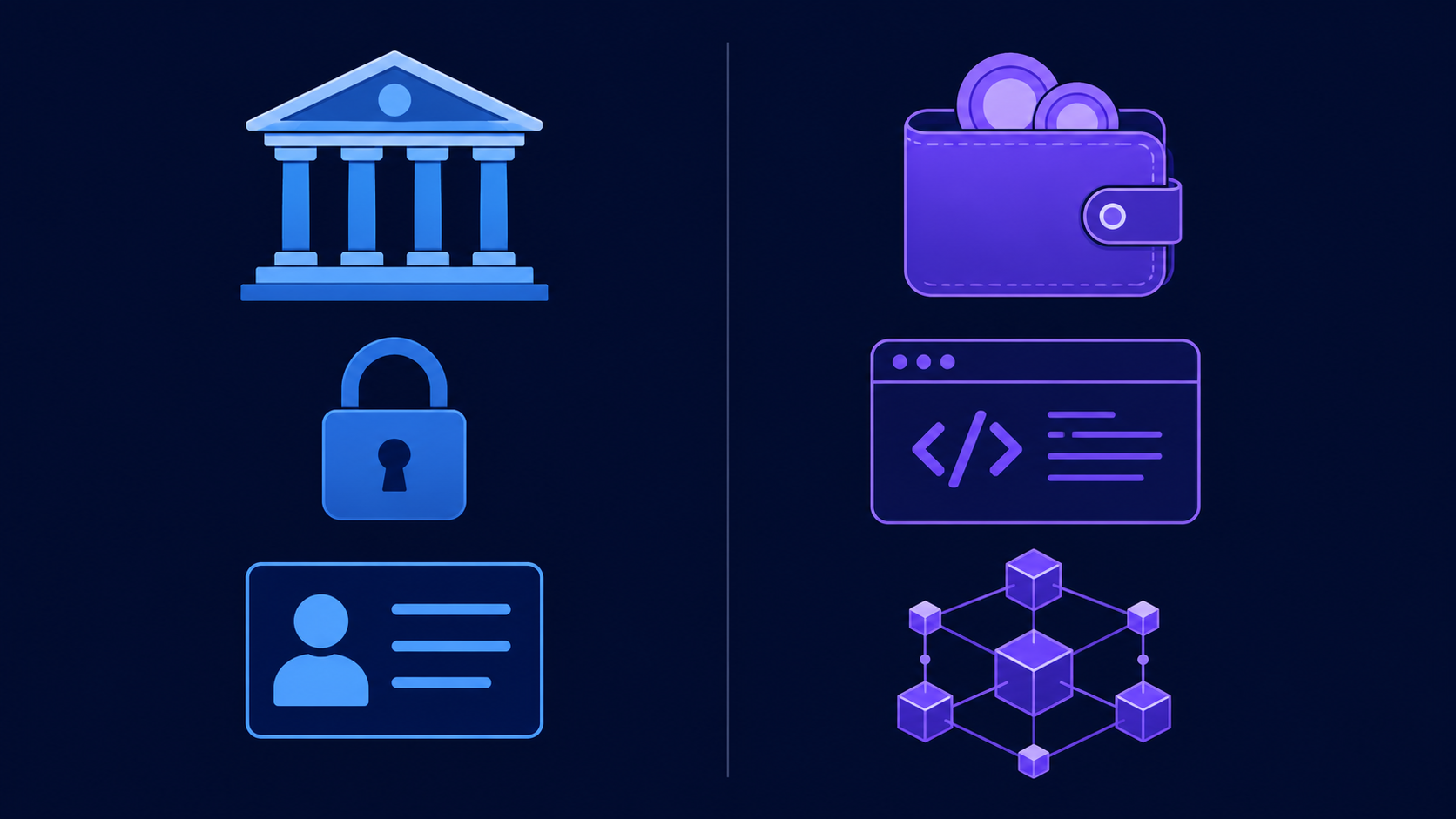
CeFi — Centralized Finance — refers to crypto products and services operated by a company or institution that acts as a middleman between you and your assets.
When you buy Bitcoin on Coinbase, deposit funds on Binance, or earn interest through a platform like BlockFi, you’re using CeFi. The company holds your assets in custody on your behalf. You log in with an email and password. If you forget your credentials, customer support can help you recover access. If you want to withdraw, the platform processes that request.
Sound familiar? It should. CeFi is essentially traditional banking rebuilt on top of crypto rails. The underlying assets are digital, but the relationship between user and institution is almost identical to what you’d find at any bank or brokerage.
That familiarity is exactly why CeFi has been the entry point for most people coming into crypto. It’s approachable, forgiving of mistakes, and requires no technical knowledge beyond creating an account.
DeFi — Decentralized Finance — removes the institution entirely. Instead of a company holding your assets and managing your transactions, smart contracts do. Instead of logging in with a username and password, you connect a self-custodied wallet. Instead of customer support, there’s code.
When you lend on Aave, swap on Uniswap, or provide liquidity on Curve, there’s no company in the middle taking custody of your funds. Your assets remain in your wallet until the moment you interact with a protocol — and even then, the smart contract executes exactly what it’s programmed to do, nothing more and nothing less.
As we’ve covered throughout this blog — in our guides on Smart Contracts, Protocols, DAOs, and DeFi Lending — DeFi is a fundamentally different architecture for financial services. Open, permissionless, and governed by code rather than corporations.
This is the most important difference, and everything else flows from it.
In CeFi, the platform holds your assets. When you deposit crypto on an exchange, you’re trusting that company to keep it safe, remain solvent, and honor your withdrawal requests. Technically, you don’t own the crypto — you own an IOU from the platform. The phrase the crypto community uses is “not your keys, not your coins.”
The consequences of this arrangement became painfully clear in 2022. When FTX collapsed, millions of users discovered that the platform had been misusing customer funds. Withdrawals were frozen. Billions in customer assets were lost. Every user who had trusted FTX with custody paid the price for that trust.
In DeFi, you hold your own assets in a self-custodied wallet. No company can freeze your funds, misuse your assets, or prevent you from withdrawing. The tradeoff is that you bear full responsibility for your own security — lose your seed phrase, and nobody can help you recover access.
CeFi platforms require identity verification — KYC (Know Your Customer) and AML (Anti-Money Laundering) checks. You provide your name, address, government ID, and sometimes proof of income. Depending on your country of residence, you may be blocked from certain platforms or products entirely.
DeFi is permissionless. Anyone with a crypto wallet and an internet connection can participate — regardless of nationality, income, credit score, or identity. No application, no approval, no gatekeeping. A farmer in rural Southeast Asia and a hedge fund manager in London access the exact same protocols on equal terms.
CeFi platforms operate like black boxes. You see your balance and transaction history, but the platform’s internal operations — how they manage reserves, where they lend customer funds, what their actual financial position is — are largely invisible. You trust their audits and disclosures, which as FTX demonstrated, can be fabricated.
DeFi is fully transparent by design. Every transaction, every smart contract, every protocol parameter is publicly visible on the blockchain. Anyone can verify exactly how much collateral backs a lending protocol, how liquidity pool reserves are distributed, or how a DAO treasury is being spent. The code is open source — readable by anyone.
Both CeFi and DeFi carry real risks, but they’re different in nature.
CeFi risks are primarily counterparty risks — the risk that the company you trust fails, defrauds you, gets hacked, or faces regulatory action. These risks are familiar because they mirror traditional financial risks: bank runs, fraud, insolvency. The FTX collapse, Celsius bankruptcy, and BlockFi shutdown all represent CeFi counterparty risk playing out at scale.
DeFi risks are primarily technical and market risks — smart contract bugs, oracle manipulation, liquidation cascades, and impermanent loss. As we covered in our Risks of DeFi and How to Avoid Crypto Scams guides, these risks are real but largely transparent and manageable with the right habits. Nobody can commit fraud with a smart contract because the code is public and executes exactly as written.
This is where CeFi wins clearly and probably always will.
CeFi is designed for mainstream adoption. Clean apps, customer support, password recovery, fiat on-ramps, intuitive interfaces. Getting started takes minutes. Mistakes are often recoverable.
DeFi requires more from the user. You manage your own wallet and seed phrase. There’s no customer support to call. Sending funds to the wrong address is permanent. Gas fees add friction. Interfaces vary in quality. The learning curve is steeper.
This gap is narrowing as DeFi tooling improves, but it remains real. The complexity of DeFi is the price of self-sovereignty — and for many users, it’s worth paying.
It’s worth noting that the line between CeFi and DeFi isn’t always clean. A growing category of products blends elements of both.
Coinbase’s Base is a Layer 2 blockchain built by a centralized company but operating as public infrastructure anyone can build on. Centralized exchanges increasingly offer DeFi-adjacent products like on-chain staking. Institutional DeFi protocols build compliance layers on top of open smart contracts to satisfy regulatory requirements while maintaining on-chain transparency.
The future of finance likely isn’t purely one or the other — it’s a spectrum, with different users choosing different points on that spectrum based on their priorities.
The honest answer is that most crypto users benefit from understanding and using both thoughtfully.
CeFi makes sense for:
DeFi makes sense for:
The transition most serious crypto users make over time is using CeFi as an on-ramp — buying crypto through an exchange — and then moving assets into self-custody and DeFi for anything beyond short-term holding.
CeFi and DeFi aren’t competing products — they’re competing philosophies about who should control your financial life.
CeFi says: trust us, we’ll handle it. DeFi says: don’t trust anyone, verify everything yourself.
Neither is wrong. Both involve tradeoffs. But in a world where major centralized crypto platforms have collapsed, frozen withdrawals, and lost customer funds, the case for understanding and using self-custodied DeFi has never been stronger.
The tools exist. The protocols are battle-tested. The guides are written. The only thing left is the decision to take control.
Educational content only — not investment, financial, tax, or legal advice. Cryptocurrency and DeFi involve substantial risk, including the potential for total loss of capital. See our full Terms & Conditions and Privacy Policy.