
Crypto moves fast. A token that gained 40% last week can lose 30% this week. A protocol that looked stable for months can drop 60% in a single day on a piece of news. Bitcoin — the most established asset in the entire space — has experienced multiple drawdowns of 80% or more from its all-time highs throughout its history.
This is volatility. And for anyone serious about building wealth through DeFi, understanding it — and managing it — is not optional.
Volatility isn’t unique to crypto. Every financial market experiences it to some degree. But crypto’s volatility is more extreme, more frequent, and more emotionally demanding than almost anything in traditional finance. The investors who build lasting wealth in this space aren’t the ones who avoid volatility — they’re the ones who understand it well enough to make rational decisions while it’s happening.
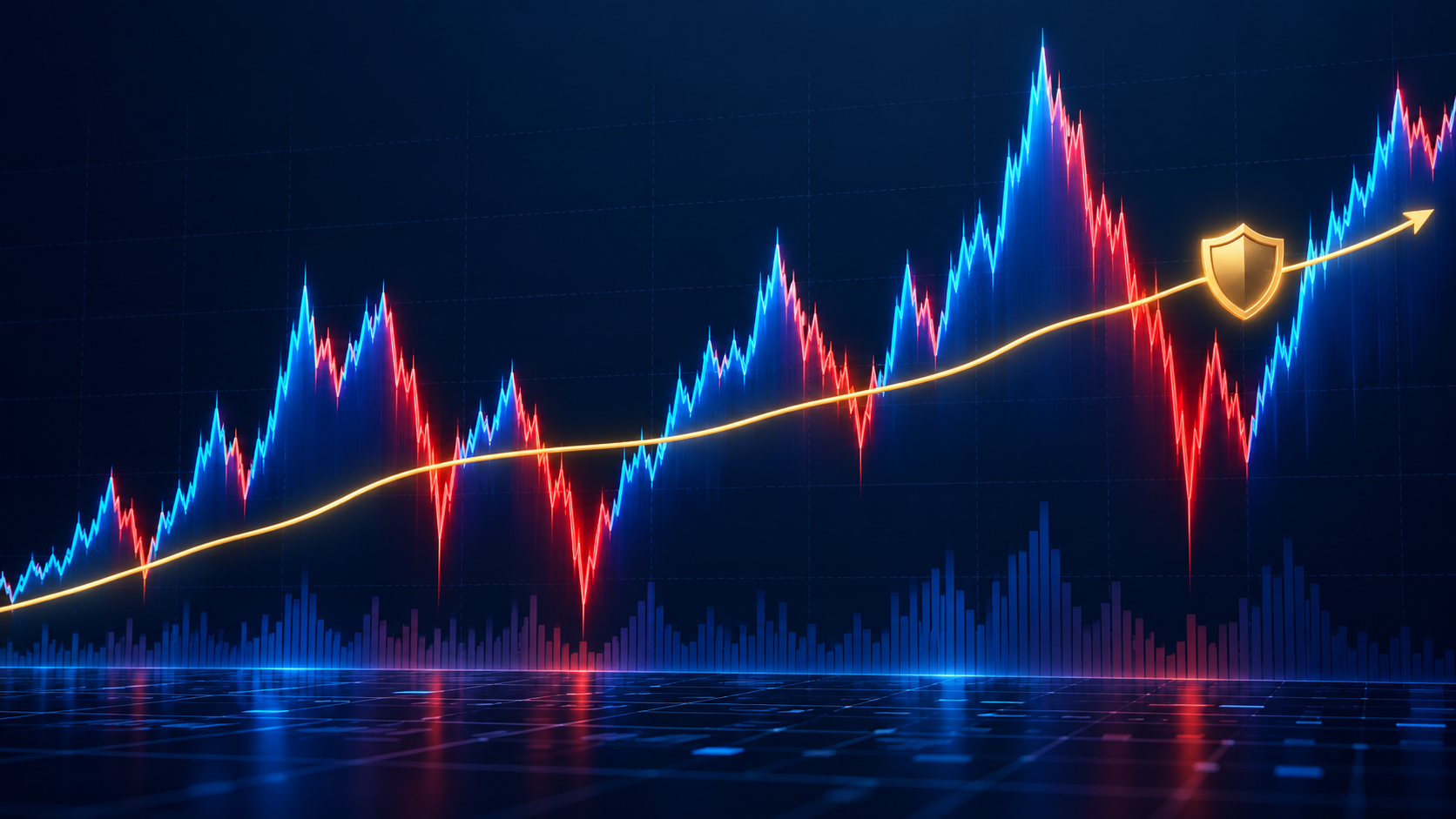
Volatility is a measure of how much an asset’s price fluctuates over time. A highly volatile asset sees large, rapid price swings in both directions. A low-volatility asset moves slowly and predictably.
In traditional finance, volatility is often measured using standard deviation — a statistical measure of how far prices deviate from their average over a given period. The higher the standard deviation, the more volatile the asset.
By this measure, crypto is extraordinarily volatile. Bitcoin’s annualized volatility has historically ranged from 50% to over 100% — compared to roughly 15–20% for the S&P 500. Smaller crypto assets and DeFi tokens are often dramatically more volatile than Bitcoin, with annualized volatility that can reach several hundred percent during peak speculative periods.
What this means practically: the price swings that would be considered extreme and newsworthy in traditional markets are routine in crypto. A 10% single-day move in Bitcoin is notable but not unusual. A 30% move in a DeFi token barely registers as remarkable. This is the environment you’re operating in.
Understanding the sources of crypto’s volatility helps you anticipate it rather than simply react to it.
Market size and liquidity. Despite its growth, crypto remains small relative to traditional financial markets. The entire crypto market cap — even at its 2021 peak of over $3 trillion — is smaller than Apple’s market cap at various points in its history. Smaller markets are inherently more susceptible to large price moves from relatively modest capital flows. A billion dollars flowing into or out of a DeFi token can move it dramatically in a way that a billion dollars flowing into or out of the US Treasury market simply cannot.
24/7 trading with no circuit breakers. Traditional stock markets have mechanisms that pause trading when prices move too far too fast — circuit breakers designed to prevent panic-driven crashes from spiraling. Crypto markets never close and have no such mechanisms. A piece of bad news at 3am on a Sunday moves prices just as freely as news during peak trading hours. There’s no cooling-off period, no market close to let sentiment reset.
Narrative-driven price action. Crypto asset prices are heavily influenced by narratives — stories about what a technology could become rather than what it currently is. When narratives shift — through regulatory news, technological developments, influential endorsements, or simply changing market sentiment — prices can reprice rapidly and dramatically in ways that don’t reflect any change in the underlying fundamentals.
Leverage and liquidations. Crypto markets support significant leverage — borrowing to amplify exposure. When prices move against leveraged positions, those positions get liquidated automatically, forcing asset sales that accelerate the very price moves causing the liquidations. This cascade effect — liquidations causing price drops causing more liquidations — is responsible for some of crypto’s most dramatic single-day crashes.
Regulatory uncertainty. News about regulatory actions, enforcement, or legislative developments can move crypto prices dramatically because the legal framework for the space remains in active development. A single regulatory announcement can reprice an entire sector in hours.
Before getting to risk management strategies, it’s worth addressing the emotional dimension of volatility — because this is where most investors actually fail.
Volatility creates two powerful and dangerous psychological states: greed during rallies and fear during drawdowns.
During rallies, rising prices feel like confirmation that everything is going right. The temptation is to increase exposure — to buy more, to use leverage, to chase the assets rising fastest. This is typically when risk is highest because valuations are stretched and the most speculative assets are performing best.
During drawdowns, falling prices feel like confirmation that everything is going wrong. The temptation is to sell — to cut losses, to exit positions, to wait for things to stabilize before re-engaging. This is typically when risk is lowest because prices are depressed and the strongest assets are on sale relative to their fundamentals.
Both impulses — buying during euphoria and selling during fear — are natural human responses that systematically produce poor investment outcomes. Recognizing this pattern in yourself before it happens is the first and most important step in managing volatility effectively.
Position sizing — the most underrated tool
The single most effective risk management strategy in volatile markets is deciding how much of your total capital to allocate to crypto in the first place — and within that, how much to allocate to any single asset or protocol.
A position you can hold through a 70% drawdown without being forced to sell — because it represents a manageable portion of your overall wealth — is a fundamentally different risk profile than a concentrated position where a 70% drawdown is financially devastating. The mathematics of crypto investing change dramatically based on how large your crypto allocation is relative to your total financial picture.
There’s no universal right answer to allocation size — it depends on your financial situation, time horizon, and risk tolerance. But the question deserves careful, deliberate thought before capital is deployed rather than after a drawdown has already occurred.
Stablecoin allocation — volatility’s antidote
Maintaining a meaningful allocation in stablecoins — USDC, USDT, or DAI — within your crypto portfolio provides a buffer against volatility in two ways. First, it reduces your overall portfolio’s volatility because stablecoins don’t fluctuate in value. Second, it preserves dry powder — capital available to deploy during drawdowns when assets are cheapest.
Many experienced crypto investors maintain 20–40% of their crypto portfolio in stablecoins during periods of high market valuation, and reduce that allocation during bear markets when they’re deploying into depressed assets. This dynamic allocation is a simple but effective volatility management tool that requires no sophisticated analysis — just the discipline to hold cash-equivalents when the temptation to be fully invested is strongest.
Dollar-cost averaging — removing timing from the equation
Dollar-cost averaging (DCA) is the practice of investing a fixed amount at regular intervals — weekly or monthly — regardless of current prices. Instead of trying to identify the optimal entry point, you buy at many different price points over time, averaging out your cost basis across the cycle.
DCA doesn’t maximize returns — a perfectly timed lump-sum investment at a market bottom will always outperform DCA mathematically. But perfect timing is impossible to achieve consistently. DCA removes the timing decision entirely and with it the anxiety that comes from trying to predict short-term price movements in an inherently unpredictable market.
For anyone building a long-term crypto position, DCA is one of the most psychologically sustainable approaches available — and sustainability matters because the investors who build wealth in this space are the ones who stay invested through multiple cycles, not the ones who execute perfect trades.
Diversification across asset types
Within a crypto portfolio, diversification reduces the impact of any single asset’s volatility on the overall portfolio. A portfolio concentrated entirely in one DeFi protocol token carries dramatically more volatility than one spread across Bitcoin, Ethereum, established DeFi protocol tokens, and stablecoins.
The correlation between crypto assets is important to understand here. During bull markets, most crypto assets tend to rise together. During bear markets, they tend to fall together. This means crypto diversification doesn’t eliminate market-wide volatility — but it does significantly reduce the risk of catastrophic loss from a single asset failing while the broader market holds up.
Avoiding leverage during volatile periods
Leverage — borrowing to amplify exposure — magnifies both gains and losses. In a volatile market, leverage transforms manageable drawdowns into margin calls and liquidations. The 2022 bear market wiped out enormous amounts of capital held by leveraged investors who might have survived the downturn comfortably on an unleveraged basis.
If you use DeFi lending protocols to borrow against your assets, maintaining a conservative Health Factor — borrowing well below your maximum — effectively limits your leverage and provides a buffer against volatility-driven liquidations. During periods of high market uncertainty, reducing leverage is one of the most straightforward risk management decisions available.
For DeFi participants specifically, volatility creates a specific challenge worth addressing: the interaction between volatile asset prices and income-generating positions.
When you provide liquidity in a pool pairing a volatile asset with a stablecoin — ETH/USDC, for example — significant price volatility in ETH increases your impermanent loss. The AMM rebalances your holdings as ETH’s price swings, potentially leaving you with less total value than if you’d held both assets without providing liquidity.
When you use volatile assets as collateral on a lending protocol, sharp price drops can push your Health Factor toward the liquidation threshold — requiring you to either add collateral, repay debt, or risk automatic liquidation.
Both of these dynamics make conservative position management more important during high-volatility periods. Stablecoin liquidity pool positions, which experience minimal impermanent loss, become relatively more attractive. Borrowing positions with healthy collateral buffers become more important to maintain.
Volatility doesn’t make DeFi steady income strategies impossible — it makes thoughtful risk management within those strategies more valuable.
Here’s the perspective that changes how most long-term investors think about volatility: over sufficiently long time horizons, crypto’s short-term volatility becomes noise within a much larger directional signal.
Bitcoin has experienced multiple 80%+ drawdowns throughout its history. It has also, from its genesis price to its most recent highs, appreciated by several million percent. An investor who held through every crash — resisting the urge to sell during the painful drawdowns — captured that appreciation. An investor who sold during any of the major crashes and waited to re-enter typically bought back higher than they sold.
This doesn’t mean crypto prices will always recover to new highs. Past performance never guarantees future results, and specific assets have gone to zero and stayed there. But it does illustrate that volatility, viewed over appropriate time horizons with appropriate position sizing, is more manageable than it feels in the moment.
The practical implication: define your time horizon before you deploy capital. If you’re investing with a multi-year perspective, short-term volatility matters much less than the quality of the assets you hold and your ability to hold them through drawdowns. If you need the capital within six months, crypto volatility is genuinely dangerous to your financial plans and your allocation should reflect that reality.
Volatility is the price of admission in crypto. It’s what creates the opportunity for significant returns — and the risk of significant losses. It’s not going away, and pretending it can be entirely managed away leads to the kind of underprepared positioning that costs investors the most during drawdowns.
What can be managed is your response to it. Position sizing that lets you hold through drawdowns. Stablecoin allocations that reduce portfolio volatility and preserve opportunity. Dollar-cost averaging that removes timing pressure. Conservative leverage management that prevents forced selling at the worst moments. And the psychological preparation to recognize that fear and greed, not market moves, are the biggest threats to long-term returns.
The investors who build wealth through crypto volatility aren’t the ones who experience less of it. They’re the ones who prepared for it, sized their positions accordingly, and made rational decisions while it was happening.
Ready to build a DeFi strategy that holds up through any market? Book a free call with the DeFi Path team — or grab the Free Playbook to get started today.
Disclaimer: Educational content only — not investment, financial, tax, or legal advice. Cryptocurrency and DeFi involve substantial risk, including the potential for total loss of capital. See our full Terms & Conditions and Privacy Policy.