
Every token swap you make on Uniswap. Every yield opportunity on Curve. Every automated trade executing instantly at any hour of the day or night. None of it would be possible without a mechanism most DeFi users have heard of but few fully understand: the liquidity pool.
Liquidity pools are the engine underneath DeFi trading. They’re why you can swap ETH for USDC in seconds without waiting for another person to take the other side of your trade. They’re why decentralized exchanges can operate 24 hours a day with no company managing the books. And they’re one of the foundational ways everyday users earn steady yield in DeFi.
Here’s exactly how they work.
To appreciate what liquidity pools do, it helps to understand the problem they replaced.
Traditional exchanges — and early crypto exchanges — use order books. A buyer posts the price they’re willing to pay. A seller posts the price they’re willing to accept. When those prices match, a trade executes. When they don’t, nothing happens — and in thin markets with few participants, that’s often.
For major assets like Bitcoin and Ethereum, order books work reasonably well. There are always enough buyers and sellers to keep the market moving. But for smaller tokens, newer projects, or trading pairs with limited interest, order books create serious illiquidity. Wide spreads. Slow execution. Trades that simply can’t fill at a reasonable price.
DeFi needed a different model — one that didn’t depend on matching buyers and sellers in real time. Liquidity pools were the answer.
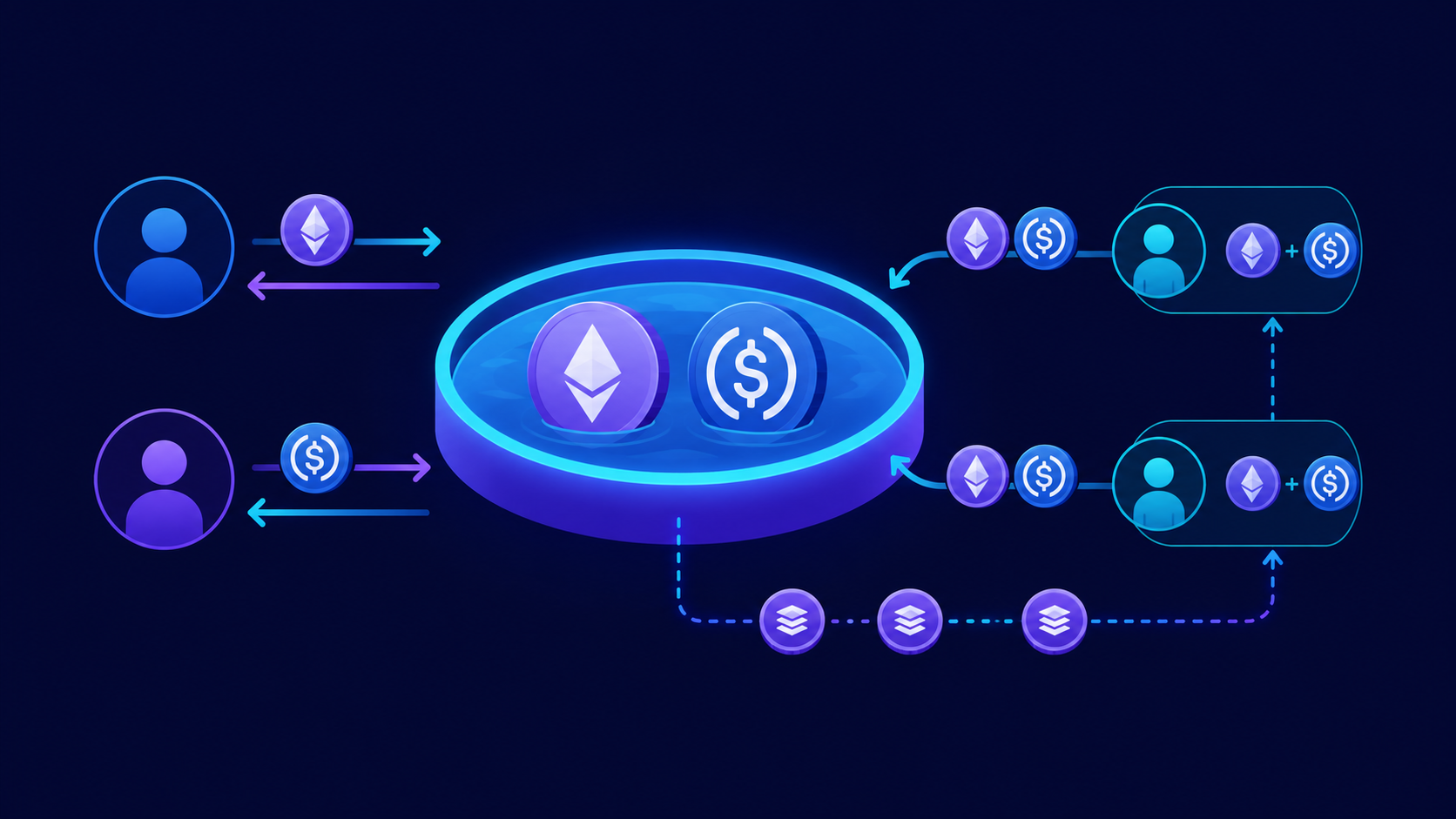
A liquidity pool is a smart contract that holds two tokens — locked there by users called liquidity providers — that anyone can trade against at any time.
Instead of matching a buyer with a seller, a trader swaps directly against the pool. Want to swap USDC for ETH? You send USDC to the pool and receive ETH from it. The pool always has both tokens available. The trade always executes. No counterparty needed.
The pool handles pricing automatically using a mathematical formula. The most widely used is the constant product formula: x × y = k — where x and y represent the quantity of each token in the pool, and k is a constant that never changes.
Here’s how it works in practice: if the pool holds 100 ETH and 200,000 USDC, the product is 20,000,000 — and k must always equal that. If a trader buys ETH, they add USDC to the pool and remove ETH. The pool now has more USDC and less ETH — so the ratio shifts, and the price of ETH rises. The formula ensures the pool self-balances with every trade, automatically reflecting supply and demand without any human intervention.
Liquidity providers — LPs — are the people who deposit funds into these pools. Anyone can do it. No application, no approval, no minimum beyond what the platform requires for gas.
To provide liquidity, you deposit equal values of both tokens in the pair. If you want to join a USDC/ETH pool when ETH is $3,000, you deposit $1,000 of USDC and $1,000 worth of ETH — roughly 0.33 ETH. The pool issues you LP tokens in return — digital receipts representing your proportional share of the pool.
Every time someone trades through the pool, they pay a small fee — typically 0.05% to 1% of the trade size depending on the platform and pool type. That fee is distributed automatically to all liquidity providers, proportional to their share of the pool.
The more trading volume a pool generates, the more fees LPs earn. High-volume pools on major platforms can generate meaningful steady yield — paid continuously, automatically, directly to your wallet.
LP tokens also unlock additional opportunities. Many DeFi protocols let you stake LP tokens in yield farms to earn bonus rewards on top of trading fees. This layering of returns — fees from the pool plus rewards from staking — is a core example of DeFi’s composability in action.
Providing liquidity earns steady yield — but it comes with a specific risk that every LP needs to understand before depositing: impermanent loss.
Impermanent loss occurs when the price of one token in your pair changes relative to the other after you’ve deposited. The AMM formula rebalances your holdings as prices shift — and that rebalancing can leave you with less total value than if you’d simply held the tokens in your wallet.
Here’s a simplified example: you deposit equal values of ETH and USDC into a pool. ETH doubles in price. Arbitrage traders buy ETH from the pool until it reflects the new market price — in doing so, they leave the pool holding more USDC and less ETH than when you deposited. When you withdraw, your share represents more USDC and less ETH than you started with. Compared to just holding both tokens, you’ve come out behind despite earning fees the entire time.
The loss is called “impermanent” because if prices return to where they were when you deposited, it disappears entirely. But in practice, prices rarely return to their exact starting point — and the loss becomes real when you withdraw.
The practical implication: pools with two assets that move together — like USDC/USDT or ETH/stETH — carry minimal impermanent loss risk because the prices rarely diverge. Pools pairing two volatile, uncorrelated assets carry more. We covered this in full detail in our Impermanent Loss guide.
Uniswap pioneered the AMM model and remains the largest DEX by volume. Uniswap v3 introduced concentrated liquidity — allowing LPs to provide liquidity within a specific price range rather than across all prices. This makes capital significantly more efficient within the chosen range but requires more active management, as positions stop earning fees if the price moves outside the range.
Curve Finance built a specialized AMM designed specifically for assets that should maintain similar prices — stablecoins and liquid staking tokens. Its custom formula minimizes slippage on these correlated pairs, making Curve the dominant venue for large stablecoin swaps. The USDC/USDT and DAI/USDC pools on Curve are among the most capital-efficient in DeFi.
PancakeSwap brought the AMM model to BNB Chain, offering lower fees and attracting massive retail adoption. It has since expanded to multiple chains and introduced features beyond basic swapping.
Balancer introduced a more flexible model: multi-token pools with customizable weightings. Instead of a fixed 50/50 split, a Balancer pool can hold three or more tokens in any ratio — enabling more complex portfolio strategies within a single liquidity position.
Liquidity pools aren’t just a trading mechanism — they’re foundational infrastructure for DeFi’s broader ecosystem.
Lending protocols use DEX liquidity pools as price oracles — reading pool ratios to determine current token values for collateral calculations. New DeFi projects launch their tokens by creating a liquidity pool before listing anywhere else — giving community members immediate trading access. Protocol treasuries maintain liquidity pools in their own tokens as a public good for their ecosystems.
And at the user level, LP positions have become a core component of DeFi portfolios — generating steady yield from the trading activity of the entire ecosystem, automatically, around the clock.
Liquidity pools transformed what was possible in decentralized finance. They replaced the order book with something more elegant: a pool of community-provided funds governed by a simple mathematical formula, capable of providing instant liquidity for any trading pair at any time.
For traders, they mean instant execution without counterparty risk. For liquidity providers, they mean steady yield from a share of every trade in the pool. For DeFi as a whole, they’re the mechanism that makes 24/7 global trading possible without a single company managing a single order book.
Everything else in DeFi builds on this foundation. The more clearly you understand liquidity pools, the more clearly the rest of the ecosystem makes sense.
Educational content only — not investment, financial, tax, or legal advice. Cryptocurrency and DeFi involve substantial risk, including the potential for total loss of capital. See our full Terms & Conditions and Privacy Policy.