
In DeFi, there are no banks, no customer support lines, and no “forgot your password” options. There’s just you, your wallet, and the blockchain. If something goes wrong — if your wallet is compromised, if your seed phrase is stolen, if you sign a malicious transaction — the funds are gone. Permanently. No one can reverse it.
This is what makes wallet security the most important skill in all of DeFi. Not yield strategies. Not protocol selection. Not gas optimization. Those all matter — but none of them matter if you lose access to your wallet first.
This guide covers what a crypto wallet actually is, the threats you need to know about, and the specific habits that keep your funds safe.
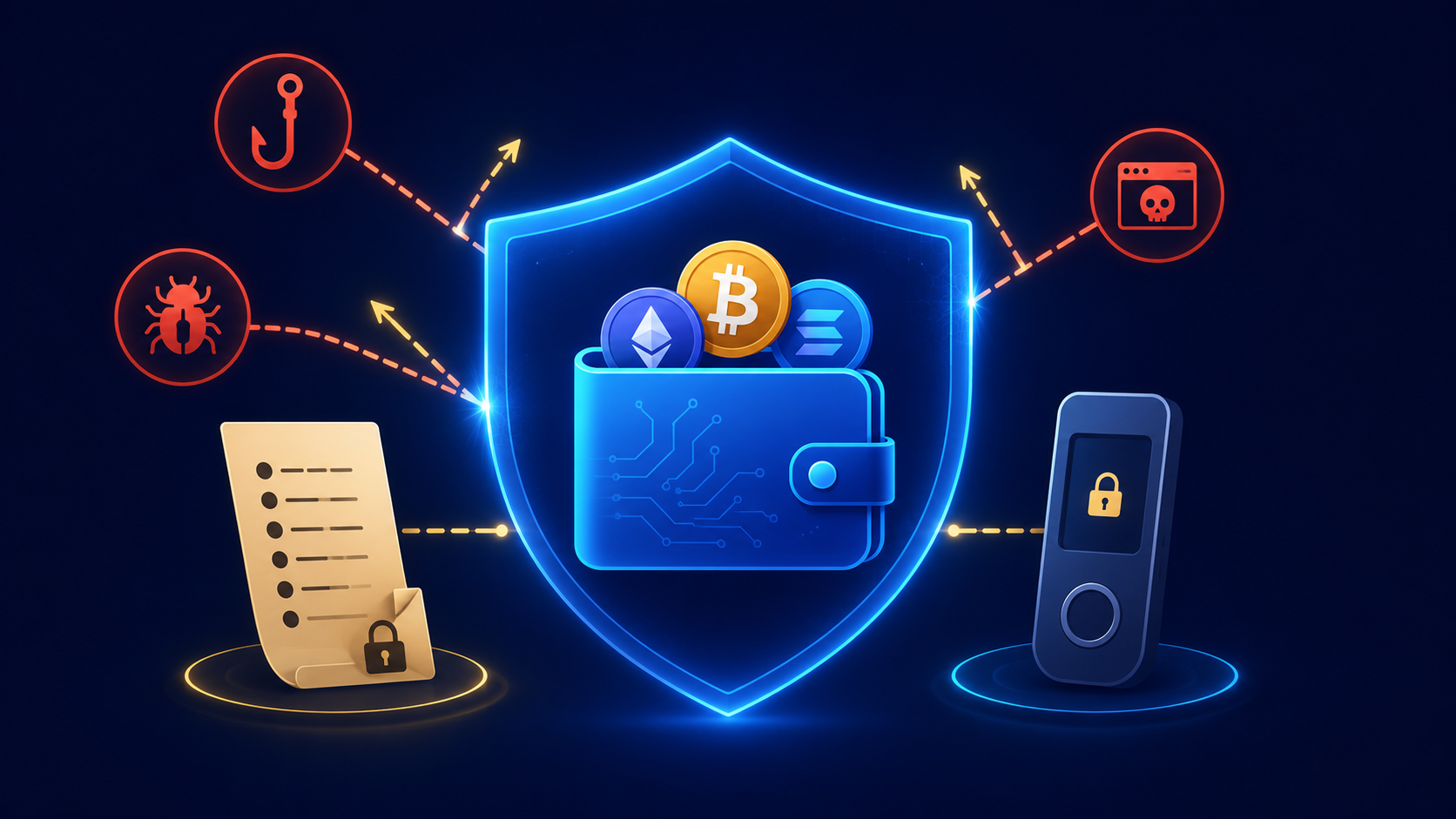
A crypto wallet is a tool that stores your private keys — the cryptographic proof that you own specific assets on the blockchain.
Here’s a common misconception: your wallet doesn’t actually hold your crypto. Your tokens live on the blockchain. What your wallet holds are the keys that prove those tokens belong to you and authorize you to move them. Think of the blockchain as a public ledger and your wallet as the only pen that can sign your entries.
Every wallet has two components:
Your public address — the string of letters and numbers that starts with “0x” on Ethereum. This is like your account number. You share it freely — it’s how people send crypto to you.
Your private key — the cryptographic password that proves you control that address and authorizes every transaction. This is never shared, never typed into any website, never photographed, never stored digitally. Anyone who has your private key has your assets.
Your seed phrase — the 12 or 24 words generated when you first create a wallet — is what mathematically generates your private key. It’s the master key to everything in your wallet. Protect it accordingly.
Not all wallets carry the same risk profile. The distinction between hot and cold storage is one of the most important concepts in crypto security.
Hot wallets are software-based and connected to the internet. MetaMask is the most widely used hot wallet in DeFi — it lives as a browser extension and connects directly to protocols with a single click. Trust Wallet and Coinbase Wallet are popular mobile alternatives. Hot wallets are convenient for regular DeFi activity — connecting to protocols, swapping tokens, managing positions — but their internet connection makes them more exposed to online threats.
Cold wallets are hardware devices that store your private keys offline. Ledger and Trezor are the two most established manufacturers. Because the private key never touches the internet, a cold wallet is significantly more resistant to remote hacking attempts. The tradeoff is convenience — every transaction requires physically confirming on the device.
The practical approach most serious DeFi users take: a hot wallet funded with only what’s needed for active DeFi interactions, and a cold wallet holding the majority of their crypto for long-term storage. This limits exposure — if your hot wallet is compromised, only the funds in it are at risk.
Understanding how wallets get compromised is the first step to preventing it. The vast majority of crypto losses come not from blockchain vulnerabilities but from specific, avoidable attack vectors.
Phishing Sites
Fake websites that look identical to real DeFi protocols are among the most common and effective attacks. You land on what looks like Uniswap or Aave, connect your wallet, and approve what appears to be a normal transaction — but the smart contract you’ve approved drains your wallet instead.
The protection is simple but requires discipline: always type URLs directly into your browser. Never click a DeFi link from Twitter, Discord, Telegram, email, or a search engine ad. Bookmark every protocol you use regularly and go directly from the bookmark. The difference between “app.uniswap.org” and “app-uniswap.org” is invisible at a glance and catastrophic if missed.
Seed Phrase Theft
The most direct attack: someone gets your seed phrase and uses it to import your wallet on their own device. This typically happens through social engineering — fake customer support agents in Discord DMs asking you to “verify” your wallet by entering your seed phrase on a website, or phishing emails claiming your wallet needs to be restored.
The rule with no exceptions: your seed phrase is never entered online, never shared with anyone, never typed into any app or website for any reason. No legitimate DeFi protocol, wallet provider, or support team will ever ask for it.
Malicious Smart Contract Approvals
Every time you interact with a DeFi protocol, you typically sign a token approval — granting that protocol permission to move a specific token from your wallet. These approvals persist indefinitely. A protocol you interacted with once six months ago still has permission to move your tokens unless you’ve revoked it.
If that protocol is later exploited or was malicious from the start, that approval becomes the attack vector. Reviewing and revoking unnecessary approvals regularly is one of the most underrated security habits in DeFi.
Malware and Device Compromise
If your phone or computer is infected with malware, attackers can record keystrokes, capture screenshots, or directly access wallet files. Clipboard hijacking — malware that replaces a copied wallet address with the attacker’s address — has cost users significant funds.
Keep your devices updated. Use dedicated devices for significant crypto activity if possible. Be extremely cautious about what software you install, particularly browser extensions that request broad permissions.
Social Engineering
Scammers impersonate protocol developers, community moderators, and support staff — particularly in Discord and Telegram. They offer to help with issues and walk you through “solutions” that end with you entering your seed phrase or signing a malicious transaction.
The baseline rule: no legitimate team member from any DeFi protocol will ever DM you first, and no legitimate solution to any problem will ever involve sharing your seed phrase.
These aren’t optional best practices. They’re the baseline for anyone holding meaningful value in a crypto wallet.
Write your seed phrase on paper — not digitally. The moment you store your seed phrase in a notes app, email draft, cloud document, or screenshot, you’ve introduced a digital attack surface. Write it on paper with a pen. Some users engrave it on metal for fire and water resistance. Store it somewhere physically secure — a safe, a lockbox, somewhere only you can access.
Never use the same wallet for everything. Keep a dedicated wallet for experimenting with new protocols and another for storing significant holdings. If something goes wrong with the experimental wallet, your main holdings are unaffected.
Verify every transaction before signing. DeFi wallets show you what a transaction will do before you confirm it. Read what’s being requested. If the approval amount is unlimited, consider setting a specific limit. If you don’t understand what a transaction is asking for, don’t sign it.
Revoke approvals regularly. Use Revoke.cash to see every active token approval on your wallet and revoke anything you no longer need. Build this into a monthly habit — it takes five minutes and meaningfully reduces your exposure.
Use a hardware wallet for significant holdings. If you’re holding more than you’re comfortable losing from a hot wallet compromise, move it to cold storage. The setup takes an hour and the security improvement is significant.
Bookmark official URLs and go directly. Phishing sites depend on you not checking the URL carefully. Remove that risk entirely by bookmarking every protocol you use and only ever accessing them from your bookmarks — never from search results, ads, or links in messages.
In DeFi, losing wallet access typically means losing your funds. There is no centralized entity to contact, no account recovery process, no transaction reversal. This is why the seed phrase backup is non-negotiable — it’s your only recovery option.
If you lose your device but have your seed phrase, you can restore your wallet on any compatible app instantly. All your assets are recoverable.
If you lose your seed phrase and your device, your funds are permanently inaccessible. No exceptions.
Store your seed phrase backup in multiple secure physical locations. Tell a trusted family member where the backup is in case of emergency — not what the words are, just where to find them. Treat it with the same seriousness you’d treat a physical key to a vault containing everything you own.
A crypto wallet is the foundation of everything you do in DeFi. It’s your identity on the blockchain, your access to every protocol, and the single point of control over all your assets. That makes it the single most important thing to protect.
The threats are real but the defenses are straightforward: understand what your seed phrase does and protect it accordingly, use a hardware wallet for significant holdings, verify every transaction before signing, revoke unnecessary approvals regularly, and never click links to DeFi protocols from social media or messages.
In traditional finance, the bank is your security system. In DeFi, you are your own bank — which means you’re also your own security system. The habits in this guide are what that responsibility looks like in practice.
Educational content only — not investment, financial, tax, or legal advice. Cryptocurrency and DeFi involve substantial risk, including the potential for total loss of capital. See our full Terms & Conditions and Privacy Policy.