A lending protocol has to know what your collateral is worth at every moment. A decentralized exchange needs to know what a token costs. A stablecoin needs to know whether it is holding its peg.
The problem is that a blockchain cannot look anything up. It only knows what has been recorded on it. So when a smart contract needs a price, someone has to deliver it, and that delivery system is called an oracle.
Oracles quietly decide when positions get liquidated, how loans are valued, and whether a protocol can be manipulated. Understanding them is one of the most useful pieces of DeFi knowledge you can have.
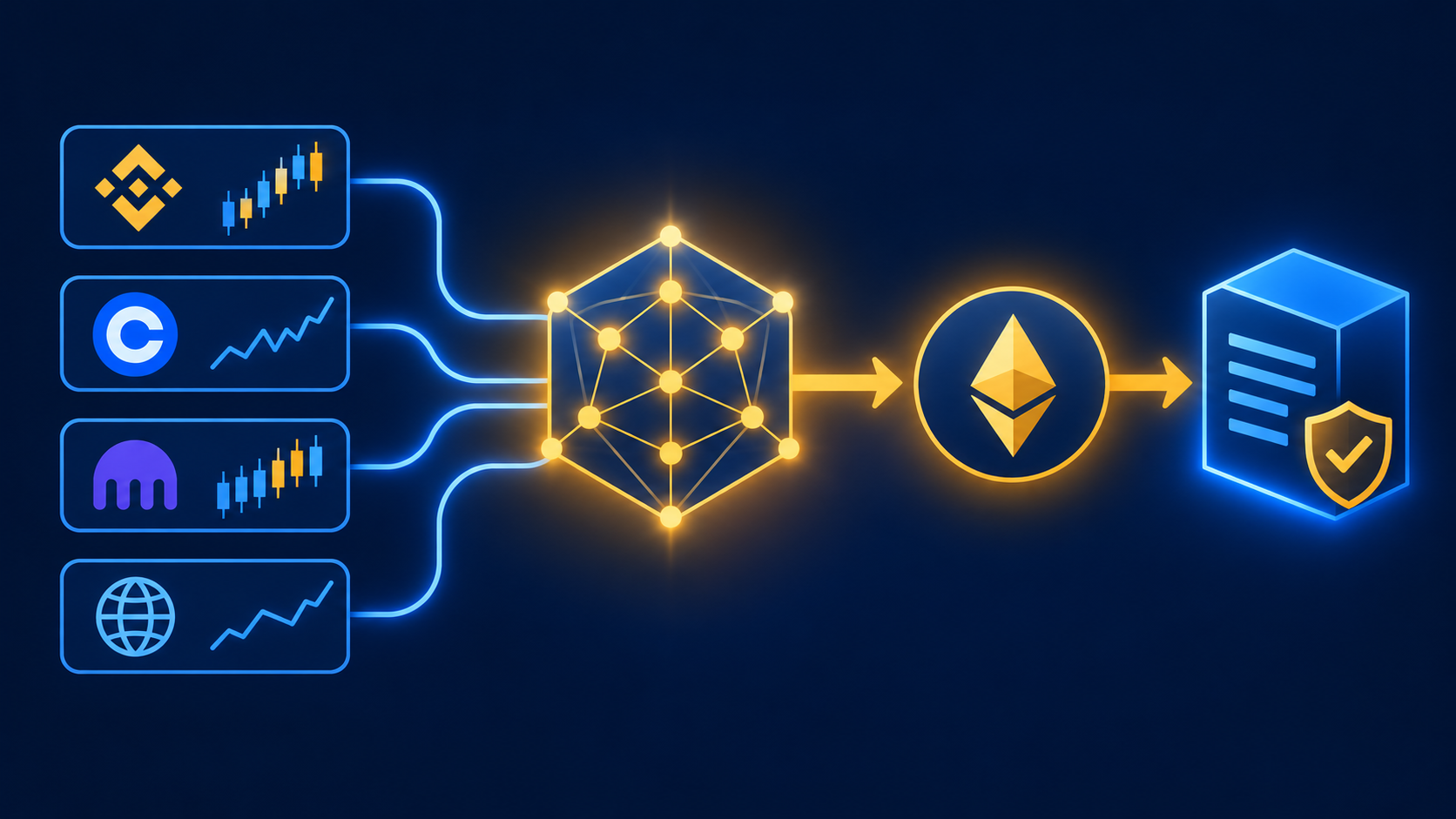
An oracle is a service that brings outside data onto a blockchain so smart contracts can use it. In DeFi, the most common data is price: the dollar value of ETH, Bitcoin, or any other asset.
Think of a smart contract as a very strict accountant who never leaves the office. It follows its rules perfectly, but it has no window to the outside world. The oracle is the messenger who walks in with the latest numbers.
Whatever number the oracle delivers, the contract treats as true. That is why oracle quality matters so much.
Most of what protects your money in DeFi runs on a price.
Lending and borrowing. Your Health Factor depends on the oracle’s price for your collateral. If the price drops, the protocol may liquidate your position automatically.
Stablecoins. Systems like DAI use price data to manage collateral and keep the peg.
Derivatives and other products. Anything that settles against a market price relies on a feed to do it correctly.
If the price is wrong, the protocol acts on bad information. A wrong price can trigger unfair liquidations, or let an attacker borrow far more than their collateral is worth.
There are two main designs.
The best-known example is Chainlink. Instead of trusting one source, a network of independent node operators each collects prices from multiple exchanges and data providers. Their answers are combined into a single aggregated price, which is then posted on-chain.
Because no single node controls the result, one bad actor or one faulty data source cannot easily distort it. Feeds typically update when the price moves by a set percentage or after a set amount of time passes, whichever comes first.
Some protocols read prices directly from decentralized exchanges. The risk is that a single trade can move a pool’s price, so a raw spot price is easy to push around.
To reduce this, many designs use a time-weighted average price (TWAP). A TWAP averages the price over a window of time, so a brief spike has little effect. An attacker would need to hold a distorted price for a long stretch, which costs far more.
Most major protocols use a decentralized oracle network, sometimes with backup feeds, rather than a single raw price source.
Oracle problems have caused some of DeFi’s costliest incidents.
Price manipulation. In several early attacks, traders used flash loans to push a thinly traded token’s price higher on one exchange. A protocol that read that price then let them borrow against inflated collateral and walk away with real funds. Mango Markets lost over $100 million in 2022 when an attacker inflated the price of its own token and borrowed against it.
Stale data. If a feed stops updating during fast markets, a protocol may act on an old price. Positions can stay open when they should have been liquidated, or be liquidated when they should not have been.
Single-source dependence. A feed that relies on one exchange or one data provider fails whenever that source fails or is manipulated.
Thin markets. Tokens with little trading volume are easy to move and hard to price fairly, which makes them risky as collateral.
Oracle risk is one reason an audit alone does not make a protocol safe. The code can be flawless while the data feeding it is not.
You do not need to read code. A few questions go a long way.
If a protocol cannot tell you where its prices come from, treat that as a red flag.
Even though you cannot control an oracle, you can plan around it.
Keep a healthy buffer on loans. A comfortable Health Factor gives you room if prices move quickly or a feed lags.
Stay with established collateral. Large, liquid assets are priced more reliably than small, thinly traded ones.
Be cautious during extreme volatility. Fast markets are when feeds are under the most strain.
Check the oracle before you deposit. It takes a few minutes in the protocol’s documentation and tells you a lot about how carefully it was built.
Smart contracts are only as reliable as the information they receive. Oracles are the link between the real market and the blockchain, and when that link is weak, even well-written code can make costly decisions.
The next time you look at a lending protocol or any product that depends on prices, ask where those prices come from. A protocol with strong, decentralized, well-documented price feeds has dealt with one of DeFi’s biggest hidden risks.
If you want guidance on building a DeFi approach that fits your goals and comfort with risk, Book a Call with the DeFi Path team or grab the Free Playbook to get started.
Disclaimer: Educational content only — not investment, financial, tax, or legal advice. Cryptocurrency and DeFi involve substantial risk, including the potential for total loss of capital. See our full Terms & Conditions and Privacy Policy.