Most people don’t lose money in DeFi because they picked the wrong strategy. They lose it because of mistakes that were entirely avoidable — errors in judgment, gaps in knowledge, or moments of impatience that cost far more than any bad trade would have.
The good news: DeFi’s most common mistakes follow recognizable patterns. Once you’ve seen them, they’re hard to repeat. This guide covers the ones that cost users the most — and exactly what to do differently.
This is the most fundamental mistake in crypto — and the most expensive when it goes wrong.
When your assets sit on a centralized exchange, you don’t actually own them. You own a claim against the exchange. If that exchange freezes withdrawals, files for bankruptcy, or turns out to have been misusing customer funds — as FTX, Celsius, and BlockFi all did — your claim may be worth very little.
The fix is straightforward: anything you’re not actively trading belongs in a self-custodied wallet. A hardware wallet for long-term holdings, a software wallet for DeFi interactions. The exchange is an on-ramp, not a storage solution.
New crypto users often treat the seed phrase as a formality — something to screenshot, store in a notes app, or jot on a Post-it. This single mistake has caused more permanent fund loss than almost any other in crypto’s history.
Your seed phrase is the only backup that exists. There’s no password reset, no customer support, no recovery process. Lose it — or let someone else see it — and your funds are gone permanently.
Write it on paper. Store it somewhere physically secure. Make a second copy for a second location. Never photograph it, type it into any website or app, or share it with anyone for any reason. No legitimate protocol, wallet provider, or support agent will ever ask for it.
A new protocol offers 400% APY on stablecoin deposits. The number is eye-catching. The question nobody asks is: where does that income come from?
Sustainable income in DeFi comes from real economic activity — trading fees, lending interest, protocol revenue. Unsustainable income comes from token emissions — the protocol minting and distributing new tokens to attract deposits. As more capital enters, the APY compresses. As token prices decline from constant selling pressure, the real return erodes. Early participants profit. Late arrivals hold depreciating tokens.
Before depositing into any income opportunity, identify the specific mechanism generating that return. If the honest answer is “token emissions from a protocol that launched last month,” treat it as speculation with a portion of capital you can afford to lose entirely — not as a core income strategy.
Every time you interact with a DeFi protocol, you sign a token approval — granting that protocol permission to spend specific tokens from your wallet. Most approvals are set to unlimited amounts. All of them persist indefinitely unless you explicitly revoke them.
An old approval from a protocol you used once eighteen months ago is still active. If that protocol is ever exploited, or if it was malicious from the start, that approval is the attack vector. Your tokens can be drained up to the approved amount — without any additional action from you.
Reviewing and revoking unnecessary approvals is one of the most impactful security habits in DeFi. Use Revoke.cash to see every active approval on your wallet. Make it a monthly habit. It takes five minutes and meaningfully reduces your attack surface.
DeFi lending protocols are powerful tools — but borrowers who maximize their position size are one bad price candle away from liquidation.
The math is straightforward: deposit $10,000 of ETH, borrow the maximum $7,500 in USDC, and a 25% drop in ETH’s price pushes your Health Factor below 1.0. The protocol automatically liquidates a portion of your collateral — at a penalty — to protect lenders. You lose collateral value, pay the liquidation fee, and still owe the remaining debt.
Experienced DeFi borrowers rarely exceed 40–50% of their maximum borrowing capacity. The buffer isn’t timidity — it’s the difference between surviving a volatile market and getting liquidated into it. If you borrow against volatile collateral, set price alerts and know your liquidation threshold before anything moves against you.
One wallet for all DeFi activity creates a single point of failure. If you interact with a malicious protocol, sign a bad transaction, or get phished through one activity, every asset across every protocol connected to that wallet is at risk.
The practical solution is wallet segmentation:
A cold wallet holds long-term savings — assets you’re not actively deploying anywhere. It interacts with nothing. It just holds.
A primary DeFi wallet handles established protocols you use regularly — Aave, Uniswap, Curve. It’s funded with meaningful but not total capital.
An experimental wallet is funded with small amounts specifically for testing new protocols, minting new tokens, or clicking links you’re not 100% certain about. If this wallet gets drained, it’s painful but not catastrophic.
This structure costs nothing and limits the blast radius of any single mistake.
This one is behavioral rather than technical — but it’s responsible for an enormous amount of preventable loss.
When crypto prices fall sharply, the emotional pull to exit is powerful. The reasoning feels logical: prices are falling, I should protect what I have left, I’ll wait until things stabilize and re-enter. What actually happens: the exit occurs near the bottom, the stabilization never feels certain enough to re-enter confidently, and the recovery happens without you.
This pattern has repeated across every crypto cycle. The investors who built lasting wealth through multiple market cycles weren’t the ones with the best market timing. They were the ones who built positions sized appropriately enough to hold through drawdowns — and did.
The practical safeguard: before entering any position, decide the percentage decline at which your thesis would be genuinely wrong versus simply uncomfortable. Uncomfortable is not a sell signal. Wrong is.
The speed of DeFi means new protocols launch constantly — some legitimate, many not. The excitement of early participation and high launch-phase income promises can override the basic research that would have revealed serious problems.
Before depositing into any protocol, a minimum check should cover: Has it been audited by a reputable firm, and are those audits publicly available? How long has it been live, and what’s the TVL history? Is the team public or at least pseudonymous with a track record? Are the tokenomics designed for sustainable income or primarily for insider enrichment?
None of these questions require technical expertise. They require five to ten minutes and the willingness to walk away if the answers aren’t satisfactory. Most rug pulls and exploits were preceded by red flags that due diligence would have surfaced.
Gas fees are fixed costs per transaction — they don’t scale with the size of your position. A $30 gas fee on a $200 deposit means your position starts at a 15% deficit before earning a single cent of return.
This doesn’t mean small positions are impossible — Layer 2 networks like Arbitrum and Optimism have reduced transaction costs to fractions of a cent, making small positions genuinely viable. But entering DeFi positions on Ethereum mainnet with small amounts, where gas costs represent a meaningful percentage of the position, is a pattern that quietly erodes returns.
Match your network choice to your position size. Mainnet for larger positions with long time horizons. Layer 2 for everything else.
The DeFi landscape evolves faster than almost any other field in finance. Protocols that were safe market leaders eighteen months ago have since been exploited. Income opportunities that seemed sustainable have compressed or disappeared. New attack vectors emerge that didn’t exist when you last reviewed your security practices.
The investors who consistently do well in DeFi aren’t necessarily the most technically sophisticated. They’re the ones who stay engaged — reading about protocol developments, reviewing their security practices periodically, and treating their DeFi knowledge as something that needs active maintenance rather than a one-time download.
Following a handful of credible DeFi security researchers, reading post-mortems when exploits occur, and reviewing your own positions quarterly are habits that compound over time in the same way good positions do.
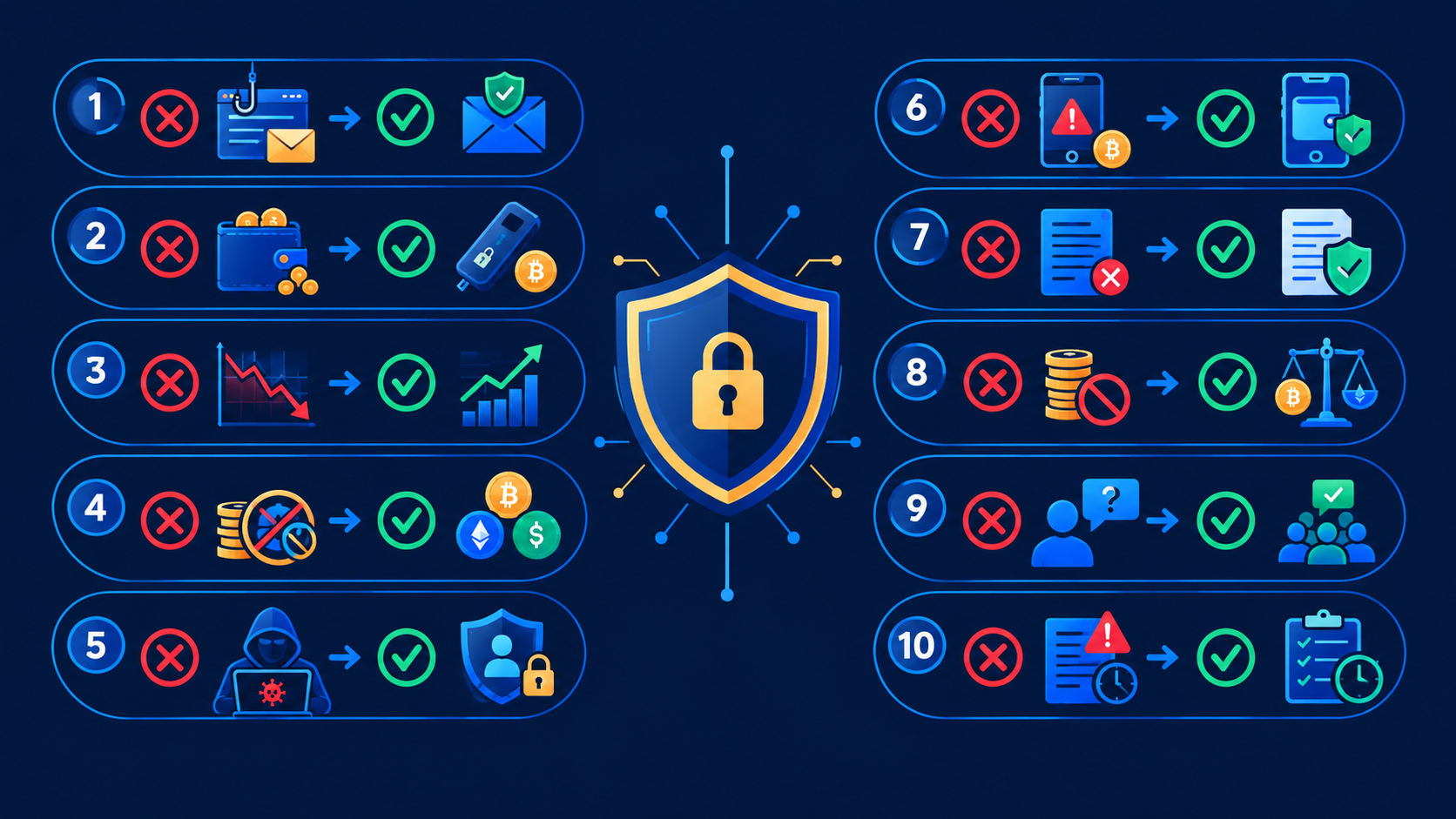
DeFi’s mistakes are not random. They cluster around the same patterns: custody failures, security oversights, income chasing without understanding the source, over-leverage, and behavioral failures under market pressure.
None of them are inevitable. Every one of them is preventable with knowledge, process, and the discipline to apply both consistently.
The most important thing this list reveals is that DeFi success isn’t primarily about finding the best opportunities — it’s about not destroying the opportunities you already have through avoidable mistakes. Protect your seed phrase. Revoke your approvals. Size your positions for survivability. Do the research before you deploy capital.
Everything else follows from getting those basics right.
Ready to build a DeFi strategy that holds up through any market? Book a free call with the DeFi Path team — or grab the Free Playbook to get started today.
Disclaimer: Educational content only — not investment, financial, tax, or legal advice. Cryptocurrency and DeFi involve substantial risk, including the potential for total loss of capital. See our full Terms & Conditions and Privacy Policy.