There's a shift happening in global finance that most people haven't noticed yet — not because it isn't significant, but because it's happening in the infrastructure layer, beneath the surface of the markets most people watch.
The world's assets are moving on-chain.
Real estate. Government bonds. Private credit. Commodities. Fine art. Infrastructure debt. Assets that have historically been locked behind institutional walls — illiquid, inaccessible, and expensive to transfer — are being converted into digital tokens on public blockchains. The process is called tokenization. And it may be the most consequential application of blockchain technology that the broader public has yet to grasp.
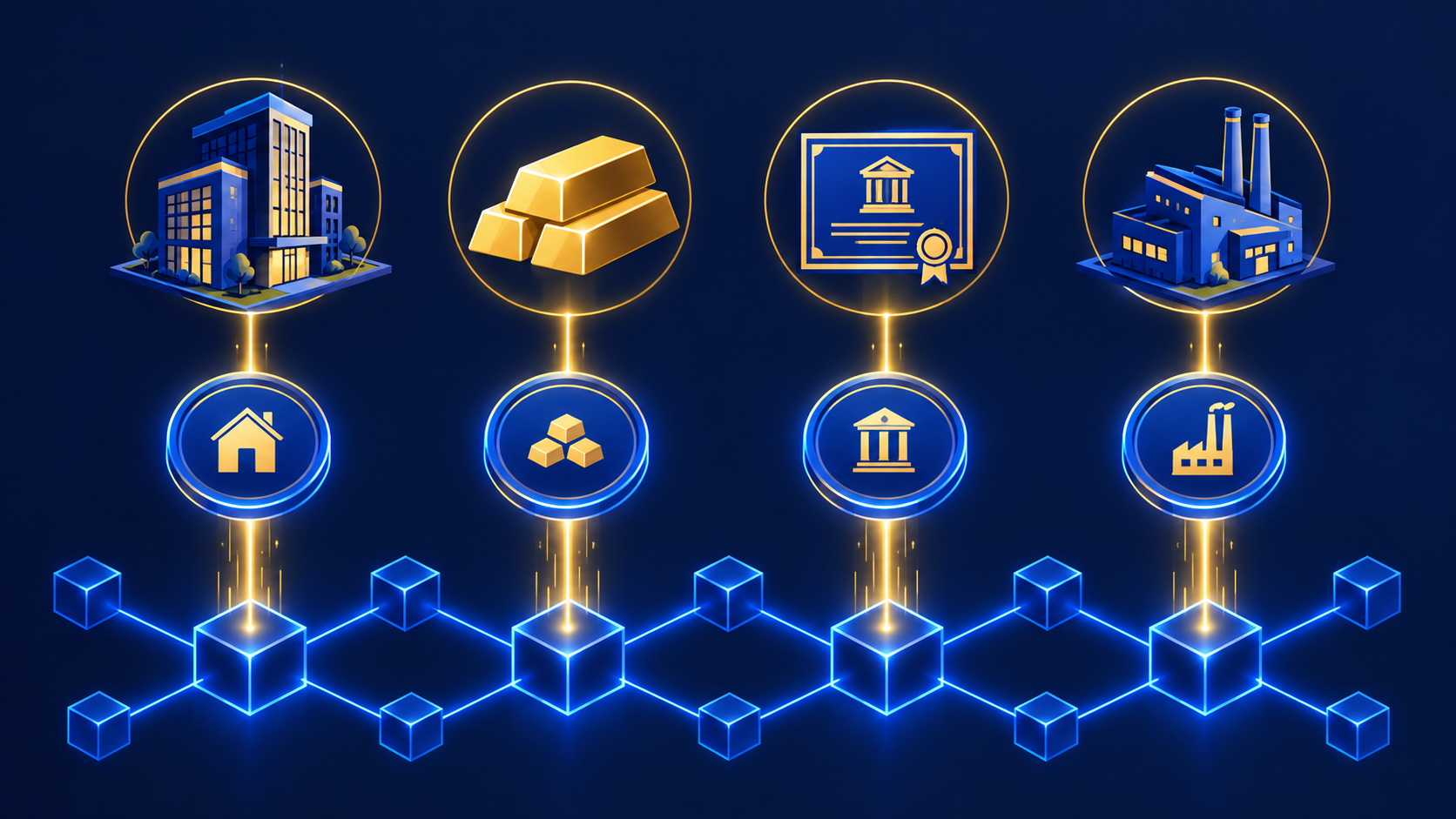
Tokenization is the process of converting rights to a real-world asset into a digital token on a blockchain.
That definition contains two important parts worth separating. First: rights to an asset — not the asset itself. When a piece of real estate is tokenized, the building doesn’t move onto a blockchain. What moves onto the blockchain is a digital representation of ownership — a token that proves you hold a specific claim on that asset and entitles you to whatever rights that claim carries: rental income, a share of sale proceeds, voting rights on management decisions.
Second: on a blockchain — meaning the token inherits all of blockchain’s properties. It’s transferable globally, instantly, 24 hours a day. It’s divisible — you can hold 0.001% of a tokenized asset as easily as 100%. It’s verifiable — anyone can confirm on-chain what tokens exist, who holds them, and what rights they represent. And it’s programmable — smart contracts can automatically distribute income, enforce transfer restrictions, and execute redemptions without any human intermediary managing the process.
This combination — real-world asset value plus blockchain’s properties — is what makes tokenization genuinely transformative rather than just a technical novelty.
To understand why tokenization matters, it helps to understand the friction in traditional asset markets.
Illiquidity is the most significant problem. Most of the world’s valuable assets — commercial real estate, private equity, infrastructure debt, fine art — are extraordinarily difficult to sell. Finding a buyer, negotiating terms, completing legal transfer, and settling the transaction can take months and cost significant percentages of the asset’s value in fees. This illiquidity premium means many assets trade at discounts to their fundamental value simply because holding them traps capital.
Accessibility is closely related. Because traditional asset markets require large minimum investments and significant transaction costs, most are effectively closed to everyone except institutional investors and high-net-worth individuals. A pension fund can buy $50 million of commercial real estate. A retail investor cannot buy $500 of the same asset. Tokenization makes fractional ownership practical — the same $50 million building can be divided into 50 million tokens worth $1 each, accessible to anyone.
Efficiency is the third problem. Traditional asset markets involve layers of intermediaries — custodians, clearinghouses, transfer agents, registrars — each adding cost and delay to transactions that could otherwise be near-instantaneous. Smart contracts replace much of this infrastructure with automated code that executes the same functions at a fraction of the cost and in a fraction of the time.
The process of bringing a real-world asset on-chain involves several steps that happen before a single token is minted.
Legal structuring comes first. The asset is typically isolated within a Special Purpose Vehicle (SPV) — a legal entity created specifically to hold that asset. The SPV issues securities or other legal instruments representing ownership of the asset. These instruments become what the tokens represent. This step is critical because it establishes the legal enforceability of the token’s claims — a token without a solid legal wrapper is a digital certificate with no enforceable rights attached.
Custody and verification follows. A regulated custodian takes responsibility for the physical or financial asset — ensuring it exists, is properly valued, and is held securely. Independent third parties verify the asset’s value and legal title. For financial assets like Treasury bills, this is straightforward. For physical assets like real estate or art, it requires appraisals, legal title searches, and ongoing monitoring.
Token issuance happens once the legal and custody infrastructure is in place. A smart contract mints tokens representing fractional ownership of the underlying asset. The number of tokens, their rights, transfer restrictions, and income distribution mechanics are all encoded in the contract.
Secondary market trading — the step that delivers on the liquidity promise — becomes possible once tokens are issued. Token holders can sell their positions on trading platforms, peer-to-peer, or in some cases on DeFi protocols, without the months-long process required to sell the underlying asset itself.
The tokenization market has moved well beyond the theoretical. Specific asset classes are already at significant scale.
US Treasury Bills and Money Market Funds
This is where institutional adoption has been most dramatic. BlackRock’s BUIDL fund — a tokenized money market fund invested in US Treasuries — crossed $1 billion in assets under management within months of launch and has continued growing. Franklin Templeton’s BENJI token and several other tokenized Treasury products now collectively represent billions in on-chain government debt.
The appeal is straightforward: Treasury bills are the world’s safest yield-generating asset. Tokenizing them makes that yield accessible on-chain — DeFi participants can hold tokenized Treasuries in their wallets, use them as collateral on lending protocols, and earn risk-free yield that’s uncorrelated with crypto market conditions.
Private Credit
Private credit — loans to businesses that aren’t publicly traded — has historically been accessible only to institutional investors willing to commit tens of millions with multi-year lockups. Tokenization platforms like Centrifuge and Maple Finance have opened this asset class to a broader set of participants by tokenizing loan portfolios and making fractional positions available on-chain.
Yields on tokenized private credit typically run 8–12% — significantly above what’s available from tokenized Treasuries — in exchange for higher risk and less liquidity than government debt.
Commodities
Gold was one of the first physical assets to be tokenized at scale. Tokens like PAXG (Paxos Gold) and XAUT (Tether Gold) each represent one troy ounce of physical gold held in professional vaults, redeemable by holders meeting minimum thresholds. Combined, gold-backed tokens represent over $1 billion in physical gold stored on behalf of token holders globally.
Other commodities — silver, oil, agricultural products — are in earlier stages of tokenization but following the same path.
Real Estate
Real estate tokenization is the most discussed and most complex category. Platforms have been tokenizing individual properties and real estate portfolios for several years, offering fractional ownership with automatic distribution of rental income. The regulatory complexity varies significantly by jurisdiction — property rights, securities law, and tenant regulations all interact with the tokenization structure in ways that require careful legal work.
For DeFi participants specifically, tokenization matters because it expands what’s usable on-chain as collateral and yield sources.
As collateral: Tokenized Treasury bills and other high-quality assets are increasingly accepted as collateral on DeFi lending protocols — enabling holders to borrow stablecoins against low-risk positions rather than only volatile crypto assets. This improves capital efficiency and introduces real-world credit quality into DeFi collateral markets.
As yield sources: As we covered in our DeFi Passive Income guide, purely crypto-native yield sources fluctuate dramatically with market conditions. Tokenized real-world assets introduce yield that comes from lending interest, rental income, and government debt — sources uncorrelated with crypto market sentiment and sustainable across market cycles.
As stable collateral for stablecoins: MakerDAO — the protocol behind DAI — has incorporated significant allocations of tokenized real-world assets into DAI’s collateral base. This improves DAI’s stability and yield profile but introduces the custodial and regulatory risks that come with real-world asset exposure.
Tokenization introduces DeFi participants to risk categories that are different from smart contract and market risk.
Legal enforceability risk is the most fundamental. A token is only as good as the legal structure backing it. In a dispute, your ability to enforce your rights as a token holder depends on the jurisdiction, the legal wrapper, and the competence and integrity of the entities managing the underlying asset. Tokens without robust legal structures are digital certificates with uncertain enforceability.
Custodial risk reintroduces counterparty trust. When you hold a tokenized Treasury, you’re trusting the custodian holding the actual Treasury bill. If that custodian fails, is defrauded, or misreports its holdings, your token’s value is affected regardless of what the blockchain says.
Regulatory risk is significant and evolving. The legal treatment of tokenized assets varies by jurisdiction and continues to develop. Assets legally structured in one jurisdiction may face challenges in others. Regulatory changes can affect whether existing tokenized assets remain compliant and tradeable.
Liquidity risk persists even with tokenization. Secondary markets for many tokenized assets remain thin — particularly for real estate and private credit tokens. The tokenization structure improves liquidity relative to the underlying asset, but it doesn’t eliminate liquidity risk entirely.
The numbers being projected for tokenization are large enough to be difficult to contextualize.
McKinsey projects the total tokenized asset market reaching $2 trillion by 2030. Other estimates, accounting for broader asset classes and faster institutional adoption, project $10–30 trillion within a decade. For context, the total DeFi ecosystem as of 2025 holds roughly $100–200 billion in TVL. Tokenization, if projections prove accurate, would dwarf everything currently in DeFi by an order of magnitude.
Whether those projections prove accurate depends on regulatory development, institutional adoption rates, and the development of secondary market infrastructure for tokenized assets. But the direction of travel is clear — and the institutional capital now building tokenization infrastructure suggests the participants with the most at stake believe the projections are achievable.
Tokenization is the process of bringing the world’s existing assets onto blockchain infrastructure — making them more liquid, more accessible, and more programmable than they’ve ever been in their traditional form.
For DeFi participants, it means the ecosystem you’re already familiar with is about to absorb an enormous amount of new asset classes, new yield sources, and new collateral types. The protocols, wallets, and skills you’ve developed in crypto-native DeFi are the same infrastructure that will interact with tokenized real estate, government bonds, and private credit as they come on-chain.
The financial system is being rebuilt. And it’s being rebuilt on the same blockchain infrastructure that powers every protocol on this blog.
Disclaimer: Educational content only — not investment, financial, tax, or legal advice. Cryptocurrency and DeFi involve substantial risk, including the potential for total loss of capital. See our full Terms & Conditions and Privacy Policy.