DeFi didn't appear overnight. It was built slowly, in layers, by developers who saw something in blockchain technology that most of the world wasn't ready to see: the possibility of a financial system with no gatekeepers.
The story of DeFi is the story of a series of problems being solved — each solution creating new possibilities, each new possibility attracting more builders, each wave of builders pushing the ecosystem further than anyone thought it could go.
Here's how it happened.
The story begins not with DeFi but with a white paper.
In October 2008, an anonymous person or group using the name Satoshi Nakamoto published “Bitcoin: A Peer-to-Peer Electronic Cash System.” The paper described a system for transferring value between two parties without a trusted intermediary — using cryptography and a distributed ledger to replace the bank.
Bitcoin launched in January 2009. Its first real-world transaction — 10,000 BTC for two pizzas in 2010 — established that digital scarcity had practical value. But Bitcoin itself was deliberately limited in scope. It was designed to do one thing well: transfer value without a middleman.
What Bitcoin proved was the concept. A decentralized network of computers could maintain a shared ledger — one that no single party controlled, one that no one could alter, one that anyone could read. If that was possible for simple value transfer, could it be extended to more complex financial operations?
That question is where DeFi begins.
In late 2013, a nineteen-year-old programmer named Vitalik Buterin published a white paper proposing something Bitcoin wasn’t designed to be: a programmable blockchain.
Buterin’s insight was straightforward but revolutionary. Bitcoin’s blockchain could record transactions. What if a blockchain could also run arbitrary code — programs that executed automatically when specific conditions were met? What if instead of just “send X to Y,” you could encode any financial logic imaginable directly into the blockchain?
Ethereum launched in 2015 with this capability built in. Smart contracts — self-executing programs stored on the blockchain — made it possible to build financial applications that ran automatically, transparently, and without any company managing them.
The first DeFi-adjacent applications appeared almost immediately. MakerDAO began development in 2015, working on a system that would allow users to lock up ETH and generate a dollar-pegged stablecoin — DAI — without a bank or custodian involved. It would take until 2017 to launch, but the vision was clear from the start: decentralized credit, backed by crypto collateral, governed by code.
The 2017 bull market brought enormous capital and attention to Ethereum — and with it, the first serious DeFi infrastructure.
MakerDAO launched DAI in December 2017. For the first time, anyone could generate a decentralized stablecoin by locking ETH as collateral in a smart contract. No bank, no company, no custodian. Just code. DAI became the foundation that much of subsequent DeFi was built on — a stable unit of account that lived entirely on-chain.
The first decentralized exchanges emerged. EtherDelta launched in 2017 as a rudimentary on-chain order book exchange — clunky and slow, but proof that token trading could happen without a centralized exchange holding user funds. It was Hayden Adams, a recently laid-off mechanical engineer, who solved the interface problem. In November 2018 he launched Uniswap — a radically simple AMM with no order book, no matching engine, just a pool of tokens governed by a mathematical formula. Uniswap worked. And it changed everything about how people thought about decentralized trading.
Compound launched in September 2018, creating the first decentralized money market — a protocol where users could supply assets and earn interest, or borrow against collateral, with interest rates set algorithmically. The concept of earning yield on crypto without trusting a centralized platform became real.
By 2019, the core infrastructure of DeFi existed: a decentralized stablecoin, a decentralized exchange, and a decentralized lending protocol. The pieces were in place. What came next was the spark.
If DeFi had a Big Bang moment, it was June 2020.
Compound did something that changed the industry overnight: it introduced liquidity mining. Users who supplied or borrowed on Compound began receiving COMP governance tokens as rewards — on top of their regular interest. For the first time, you could earn tokens simply for using a protocol.
The effect was immediate and dramatic. Capital flooded into Compound chasing COMP rewards. Other protocols copied the model instantly. Within weeks, dozens of projects were launching with their own governance tokens, their own liquidity mining programs, their own yield opportunities.
This period became known as DeFi Summer — and the numbers were staggering. Total Value Locked across DeFi protocols grew from under $1 billion in June 2020 to over $10 billion by September. Yearn Finance launched and automated yield optimization, moving capital automatically to wherever the best returns were. SushiSwap forked Uniswap’s code and launched its own governance token, sparking a liquidity war that introduced millions to the concept of protocol competition.
New concepts emerged almost daily. Yield farming. Liquidity mining. Protocol-owned liquidity. Flash loans. Composability — the ability of protocols to plug into each other like building blocks — created entirely new financial instruments that hadn’t existed six months earlier.
DeFi Summer was chaotic, risky, and filled with projects that would later fail. It was also the moment DeFi went from a niche experiment to a phenomenon the entire financial world had to pay attention to.
The 2021 bull market took everything from DeFi Summer and amplified it.
Total Value Locked across DeFi peaked at over $250 billion. Uniswap v3 launched with concentrated liquidity, dramatically improving capital efficiency for liquidity providers. Aave expanded to multiple chains and introduced new collateral types. MakerDAO grew DAI supply into the billions.
Layer 2 networks began gaining serious traction. Arbitrum launched in August 2021, offering Ethereum-compatible DeFi at a fraction of the gas cost. Optimism followed. The scaling solutions that would eventually bring DeFi to a much broader user base were finding their feet.
NFTs exploded into mainstream consciousness — and while not strictly DeFi, they shared the same infrastructure and brought an entirely new audience into the Ethereum ecosystem. The cultural moment of 2021 — crypto art, profile picture collections, digital ownership — introduced millions to wallets, gas fees, and on-chain transactions who might never have engaged with lending protocols directly.
Institutional interest arrived in force. MicroStrategy, Tesla, and Square had added Bitcoin to their balance sheets. Venture capital flooded into DeFi projects at unprecedented valuations. The conversation shifted from “is this real?” to “how big can this get?”
2022 was DeFi’s most painful year — and its most instructive.
In May, the Terra/Luna ecosystem collapsed. UST — an algorithmic stablecoin that maintained its peg through a mechanism linking it to the LUNA token — lost its peg in a death spiral that destroyed approximately $60 billion in value within days. Millions of users who had trusted UST’s high yields lost everything. The event demonstrated brutally that not all stablecoin designs are equally robust — and that high yields without sustainable mechanisms are a warning sign, not an opportunity.
The contagion spread. Celsius Network — a centralized crypto lender offering high yields — froze withdrawals and later filed for bankruptcy. Three Arrows Capital — one of crypto’s largest hedge funds — collapsed with billions in losses. And in November, FTX — at the time the second-largest crypto exchange in the world — imploded in a fraud scandal that sent shockwaves through the entire industry.
What the 2022 bear market revealed was the distinction between genuine DeFi and centralized entities using DeFi’s language. Aave, Uniswap, Compound, MakerDAO — the actual decentralized protocols — continued functioning exactly as designed throughout the entire crisis. No withdrawals were frozen. No customer funds were misused. The code kept running.
The protocols that failed in 2022 were almost universally centralized entities — companies making opaque decisions with user funds, operating with leverage they couldn’t survive when markets moved against them. The bear market was brutal, but it clarified something important: genuine DeFi is more resilient than the centralized alternatives that surrounded it.
The recovery from 2022 was slower and more deliberate than previous cycles — and fundamentally different in character.
Institutional adoption moved from curious to committed. BlackRock launched a tokenized money market fund on Ethereum. Franklin Templeton tokenized funds on multiple chains. JP Morgan ran tokenized repo transactions. As we covered in our Real World Assets guide, the tokenization of traditional financial instruments — Treasury bills, private credit, real estate — became one of the fastest-growing sectors in DeFi.
Regulatory clarity began arriving. The EU’s MiCA framework established comprehensive crypto regulation. The US passed the GENIUS Act establishing a stablecoin framework. For the first time, institutions had legal clarity that made large-scale DeFi participation viable.
Layer 2 networks matured dramatically. EIP-4844 in early 2024 reduced Layer 2 transaction costs by up to 90% overnight. Arbitrum, Optimism, Base, and zkSync processed billions in daily transactions. The scaling problem that had made DeFi impractical for small users was being systematically solved.
By 2025 the DeFi ecosystem looked meaningfully different from what it had been in 2020. More capital. More institutional participation. More regulatory structure. Better infrastructure. And — critically — more battle-tested protocols that had survived multiple market cycles and emerged with their core mechanics proven.
Looking back at DeFi’s evolution, a few patterns stand out clearly.
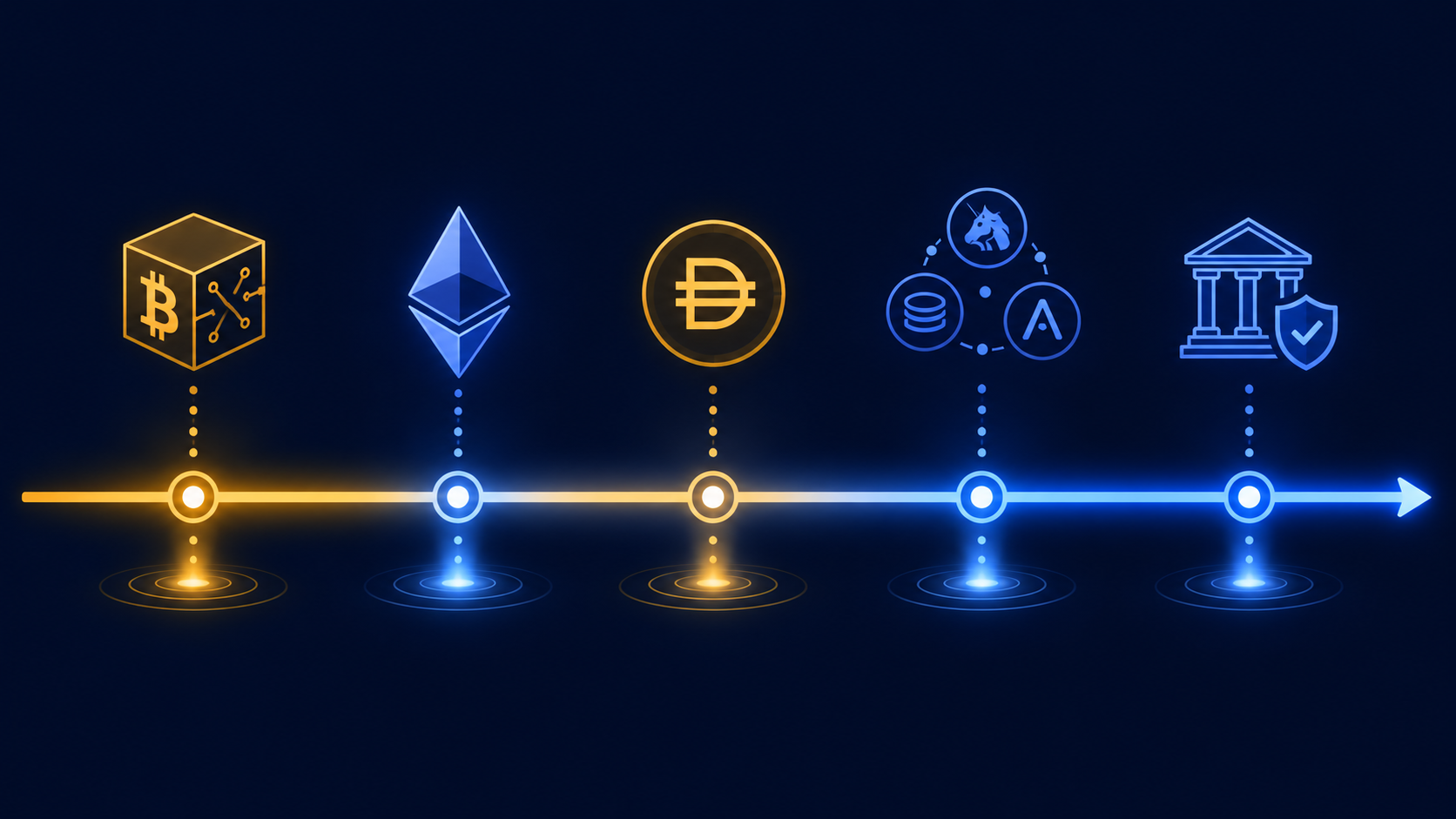
Every cycle builds on the last. Bitcoin proved digital scarcity. Ethereum proved programmable finance. DeFi Summer proved that community-governed protocols could attract massive capital. The institutional wave is proving that on-chain finance can meet traditional finance’s requirements. Each phase expands what the next phase can build on.
The genuine protocols survive. The 2022 bear market was devastating — but it was devastating primarily for centralized entities operating with hidden leverage and misused customer funds. The actual DeFi protocols kept running. Aave processed withdrawals. Uniswap processed trades. MakerDAO maintained DAI’s peg. Resilience in adversity is the best proof of sound design.
The infrastructure keeps improving. Gas fees that were prohibitive in 2021 are fractions of a cent on Layer 2 in 2025. User experience that required significant technical knowledge is becoming progressively more accessible. The gap between what DeFi can do and what mainstream users can easily access is closing — not as fast as enthusiasts would like, but measurably and consistently.
DeFi’s history is a fifteen-year story of a simple idea being built into increasingly complex and capable infrastructure — one protocol, one innovation, one market cycle at a time.
It started with the question of whether two parties could transact without trusting a bank. Today it’s asking whether the entire global financial system can be rebuilt on open, programmable, permissionless infrastructure. The answer isn’t complete yet — but the direction of travel has never been clearer.
Understanding where DeFi came from makes where it’s going much easier to see. And for anyone engaged with the ecosystem today, that perspective is worth having.
Disclaimer: Educational content only — not investment, financial, tax, or legal advice. Cryptocurrency and DeFi involve substantial risk, including the potential for total loss of capital. See our full Terms & Conditions and Privacy Policy.