Spend five minutes in any crypto community and you'll hear both words used constantly — sometimes interchangeably, sometimes as if they mean completely different things. Coin. Token. Are they the same? Is there a difference? Does it matter?
It does matter — and the distinction is simpler than most explanations make it sound. Understanding the difference between coins and tokens changes how you read project documentation, evaluate DeFi protocols, and think about the assets you hold.
Here's the complete picture.
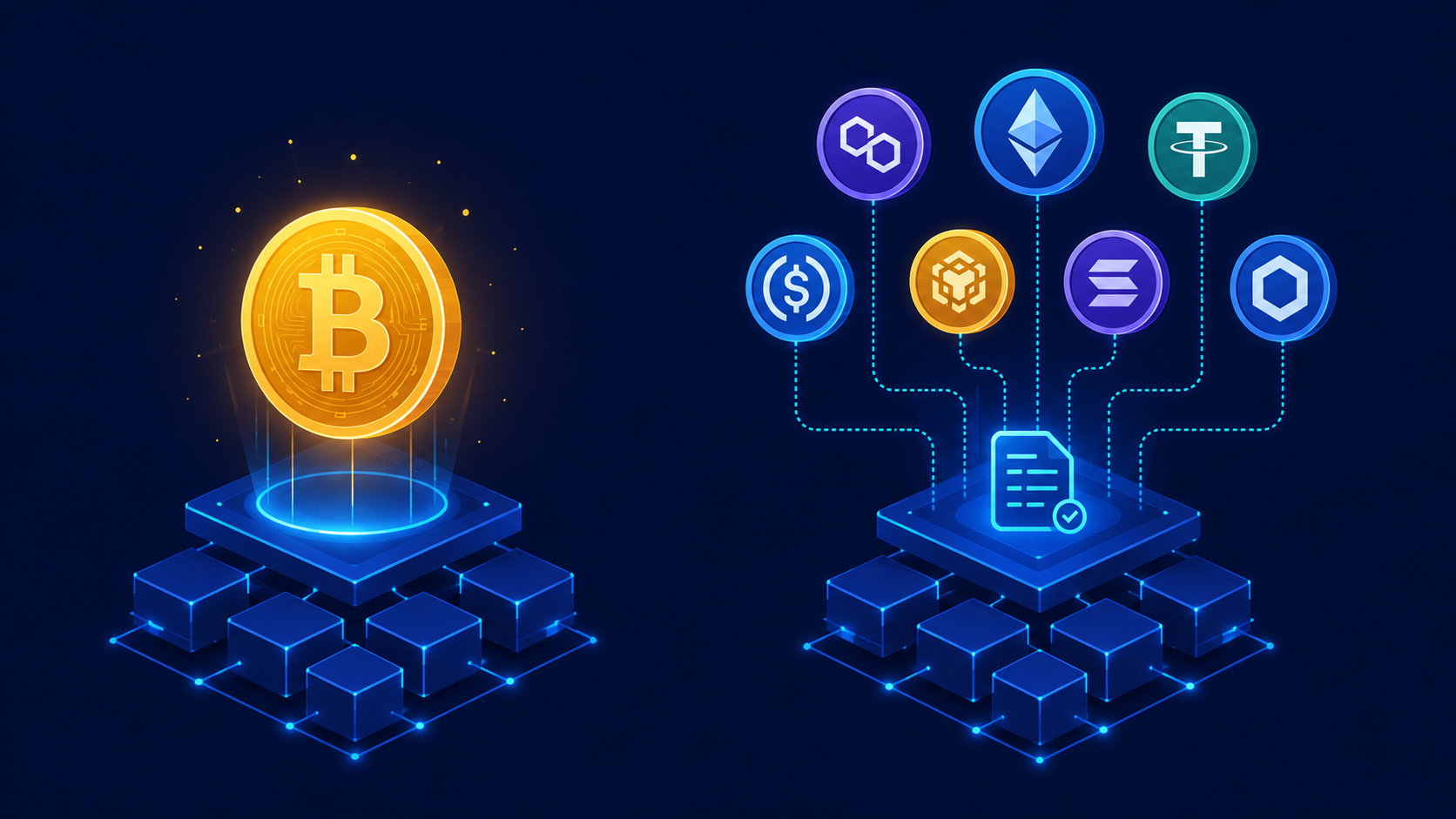
The difference between a coin and a token comes down to one thing: where it lives.
A coin is the native currency of its own blockchain. It’s built directly into the blockchain’s infrastructure — used to pay transaction fees, reward validators, and power the network itself.
A token is built on top of an existing blockchain using a smart contract. It doesn’t have its own blockchain — it lives on someone else’s infrastructure and follows the rules of that underlying chain.
Every blockchain has one native coin. Everything else built on top of that blockchain is a token.
Bitcoin (BTC) is the native coin of the Bitcoin blockchain. Every transaction on Bitcoin’s network costs BTC in fees. Miners who secure the network are rewarded in BTC. The entire blockchain was built around this single asset.
Ethereum (ETH) is the native coin of the Ethereum blockchain. Gas fees on Ethereum are paid in ETH. Validators who secure the network earn ETH. As we covered in our Ethereum guide, ETH is the fuel that makes the entire Ethereum ecosystem run.
SOL is the native coin of Solana. AVAX is the native coin of Avalanche. MATIC (now POL) is the native coin of Polygon. Every blockchain has exactly one native coin — and that coin exists at the protocol level, not through a smart contract.
This is what makes coins fundamentally different from tokens. You cannot create a new native coin by writing a smart contract. The coin is baked into the blockchain itself from the beginning.
Tokens are created by deploying a smart contract on an existing blockchain. The smart contract defines the token’s rules — its name, its symbol, its total supply, how it can be transferred, and any additional functionality built into it.
On Ethereum, most tokens follow a standard called ERC-20 — a set of rules that ensures all tokens work the same way and can be used by wallets, exchanges, and DeFi protocols without custom integration for each one. When you see a token listed as ERC-20, it means it was created using this standard on Ethereum.
This is why Ethereum hosts thousands of different tokens — USDC, DAI, LINK, UNI, AAVE, and countless others — alongside its native coin ETH. Each of those tokens is a separate smart contract living on Ethereum’s blockchain, but none of them is ETH itself.
The same principle applies on other chains. Tokens on BNB Chain follow the BEP-20 standard. Tokens on Solana follow the SPL standard. Different chains, same concept.
Understanding that something is a token tells you where it lives. Understanding what kind of token it is tells you what it does. Here are the three categories you’ll encounter most in DeFi.
Utility tokens give their holders access to a specific product, service, or function within a protocol. They’re the working currency of DeFi ecosystems.
LINK (Chainlink) is used to pay node operators who provide price data to DeFi protocols. GRT (The Graph) is used to pay indexers who make blockchain data queryable. These tokens have a functional purpose built directly into the protocol — holding them gives you access to something the network provides.
In DeFi specifically, many protocol tokens have utility baked in — fee discounts, governance rights, or the ability to participate in specific protocol functions that require the token.
Governance tokens give their holders voting rights over a protocol’s future development. As we covered in our DAOs guide, DeFi protocols are typically governed by their communities through on-chain voting — and governance tokens are the mechanism that makes this possible.
UNI (Uniswap), AAVE (Aave), COMP (Compound), and MKR (MakerDAO) are all governance tokens. Holding them gives you the right to vote on protocol proposals — fee changes, new asset listings, treasury allocations, and smart contract upgrades.
Governance tokens often serve dual purposes: voting rights plus some form of value capture from protocol activity. The balance between these functions varies significantly by protocol and is worth understanding before buying any governance token purely for yield.
Stablecoins are tokens designed to maintain a fixed value — typically $1. As we explored in our Stablecoins guide and USDC vs DAI guide, they’re the bridge between crypto volatility and dollar stability within the DeFi ecosystem.
USDC and USDT are tokens — not coins — even though they represent dollar value. They’re smart contracts on Ethereum (and other chains) that maintain their peg through either fiat backing or crypto collateralization. They live on Ethereum’s infrastructure just like any other ERC-20 token.
This is worth internalizing: when you hold USDC on Ethereum, you’re holding an Ethereum token, which means you’re subject to Ethereum’s gas fees for every transfer and interaction — even though the token itself represents a dollar.
Understanding coins vs tokens isn’t just academic — it has direct practical implications for how you use DeFi.
Gas fees are always paid in the native coin. No matter what token you’re transacting with on Ethereum, gas fees are always paid in ETH. Swap USDC for DAI and you pay ETH in fees. Deposit LINK into Aave and you pay ETH in fees. This catches many beginners off guard — running out of ETH means your transactions don’t go through even if you have plenty of other tokens in your wallet.
Bridging changes what you hold. When you bridge ETH from Ethereum to Arbitrum, you receive wrapped ETH on Arbitrum — technically a token representing ETH, not native ETH itself. The native coin of Arbitrum for gas fees is still ETH, but the bridging mechanics mean you’re working with a token version of it. Understanding this distinction helps you understand why bridging has its own risk profile.
Token contracts can be upgraded or have bugs. Because tokens are smart contracts, they carry smart contract risk that native coins don’t. A bug in an ERC-20 token contract could affect that specific token without affecting ETH itself. This is one reason why established tokens with long track records and audited contracts are generally safer to hold than newly deployed ones.
Not all tokens of the same name are the same asset. Because creating a token is as simple as deploying a smart contract, scammers frequently create fake tokens using the names and symbols of legitimate assets. There is only one official USDC contract address — any other contract claiming to be USDC is a fake. Always verify token contract addresses against official sources before interacting with them.
You’ll frequently encounter tokens with a “W” prefix in DeFi — WETH (Wrapped ETH), WBTC (Wrapped Bitcoin). These deserve a brief explanation.
Wrapped tokens are ERC-20 token versions of assets that aren’t natively ERC-20. ETH itself predates the ERC-20 standard and isn’t technically compatible with it — so WETH was created as an ERC-20 wrapper around ETH that DeFi protocols can interact with using standardized functions. Bitcoin doesn’t exist on Ethereum at all — WBTC is a token on Ethereum that represents Bitcoin held in custody, allowing BTC holders to participate in Ethereum DeFi.
Wrapped tokens are always redeemable for the underlying asset at a 1:1 ratio — that’s what makes them useful. But they introduce custodial or smart contract risk depending on how they’re structured. WBTC, for example, depends on a custodian holding the actual Bitcoin that backs each token.
| Coins | Tokens | |
|---|---|---|
| Lives on | Its own blockchain | Another blockchain’s smart contract |
| Examples | BTC, ETH, SOL, AVAX | USDC, UNI, AAVE, LINK, DAI |
| Created by | Built into the protocol | Smart contract deployment |
| Used for | Gas fees, network security | Utility, governance, value transfer |
| Standard | Protocol-native | ERC-20, BEP-20, SPL, etc. |
| Smart contract risk | No | Yes |
Coins power blockchains. Tokens are built on top of them.
Every time you interact with DeFi — swapping on Uniswap, lending on Aave, voting on a governance proposal — you’re almost certainly working with tokens. The governance rights, the stablecoins, the yield-bearing assets, the protocol rewards — all tokens, all living on blockchain infrastructure powered by native coins.
Understanding this distinction gives you a clearer mental model of how everything in DeFi connects. When you know that USDC is a token on Ethereum, you understand why you need ETH to move it. When you know that UNI is a governance token, you understand what holding it actually gives you.
The vocabulary of crypto is built on this foundation. Get it right and everything else gets clearer.
Disclaimer: Educational content only — not investment, financial, tax, or legal advice. Cryptocurrency and DeFi involve substantial risk, including the potential for total loss of capital. See our full Terms & Conditions and Privacy Policy.