
Every industry has its own language. Medicine has diagnoses and dosages. Law has statutes and precedents. DeFi has TVL, APY, liquidity pools, and slippage — and if nobody explains what those words mean, the whole space feels like a members-only club you weren't invited to join.
This guide is your invitation.
Whether you've just heard about DeFi for the first time or you've been exploring it for a few weeks and keep hitting walls of unfamiliar terminology, this is the reference you keep open in a tab. Ten terms. Plain English. Real examples. No jargon explaining jargon.
By the end, the language of DeFi will feel familiar — and the protocols, strategies, and opportunities covered across this blog will start making a lot more sense.
Everything in DeFi starts with a wallet — so this is where we start too.
A crypto wallet is a tool that holds your private keys — the cryptographic proof that you own your on-chain assets. Unlike a physical wallet that holds cash, a crypto wallet doesn’t actually store your tokens. Your tokens live on the blockchain. The wallet holds the keys that prove they belong to you and allow you to authorize transactions.
There are two main types. A hot wallet is software-based and connected to the internet — MetaMask is the most widely used example. Convenient for regular DeFi use, but more exposed to online threats. A cold wallet is a hardware device stored offline — Ledger and Trezor are the leading examples. More secure for long-term storage of significant holdings.
The most important thing to understand about wallets: your seed phrase — the 12 or 24 words generated when you create a wallet — is the master key to everything inside it. Anyone who has your seed phrase has your assets. Write it down offline, store it somewhere secure, and never share it with anyone under any circumstances.
We covered wallet setup and safety in depth in our Crypto Wallet Safety guide.
Your private key is the cryptographic password that proves you own a specific wallet address and authorizes transactions from it.
Think of it this way: your wallet address is like your email address — public, shareable, how people send things to you. Your private key is like your email password — private, known only to you, and what gives you access.
Your seed phrase mathematically generates your private key. Lose your seed phrase, lose your private key, lose your assets — permanently. There is no customer support, no password reset, no recovery process. This is what self-custody means in practice.
Never enter your private key or seed phrase into any website, app, or form that asks for it. Legitimate DeFi protocols never need your private key to function.
A smart contract is self-executing code stored on the blockchain that automatically carries out a set of predefined rules when specific conditions are met — with no human intervention required.
Here’s a practical example: when you swap USDC for ETH on Uniswap, a smart contract handles every step automatically. It checks the current exchange rate, calculates your output, takes your USDC, gives you ETH, and records everything on the blockchain — all in a single transaction, in seconds, with no company or person in the middle making it happen.
Smart contracts are what make DeFi possible. They replace the banks, brokers, and intermediaries of traditional finance with code that anyone can read, anyone can verify, and no one can alter once deployed.
The tradeoff is that bugs in smart contracts can be exploited. As we covered in our Risks of DeFi guide, smart contract risk is the one threat in DeFi that no amount of personal caution fully eliminates — which is why sticking to audited, battle-tested protocols matters.
A liquidity pool is a collection of two tokens locked in a smart contract that enables trading on a decentralized exchange.
Traditional exchanges match buyers with sellers through order books. DeFi exchanges don’t wait for matching buyers and sellers — instead, traders swap directly against a pool of funds provided by liquidity providers (LPs). The pool automatically adjusts prices based on the ratio of tokens it holds, ensuring trades can always execute.
Example: a USDC/ETH liquidity pool holds both USDC and ETH. When someone buys ETH from the pool, they deposit USDC and withdraw ETH. The pool now holds more USDC and less ETH, so the price of ETH rises slightly to reflect the changed ratio.
Liquidity providers deposit equal values of both tokens into a pool and earn a share of the trading fees generated by every swap. As we covered in our Liquidity Pools guide and Impermanent Loss guide, providing liquidity earns steady yield but comes with specific risks — most notably impermanent loss when token prices diverge.
You’ll see both of these terms everywhere in DeFi — and they’re not the same thing.
APR (Annual Percentage Rate) is the simple interest rate you earn over a year, without accounting for compounding. If a protocol offers 10% APR, you earn 10% on your principal over twelve months — calculated as a straight percentage.
APY (Annual Percentage Yield) accounts for the effect of compounding — earning interest on your interest. At 10% APY with daily compounding, your effective return is slightly higher than 10% because each day’s interest is added to the principal before the next day’s interest is calculated.
In DeFi, protocols that automatically reinvest your earnings will show APY. Protocols where you manually claim and reinvest rewards will typically show APR. Always check which one is being quoted before comparing yields across platforms — the difference can be significant, especially at higher rates.
The practical rule: APY is more relevant for positions where compounding happens automatically. APR is more relevant when you’re manually managing reinvestment.
TVL stands for Total Value Locked — the total dollar value of assets currently deposited in a DeFi protocol.
When you deposit $1,000 of USDC into Aave, that $1,000 becomes part of Aave’s TVL. Add up every deposit from every user across every supported asset, and you have the protocol’s total TVL.
TVL is the most widely used metric for assessing the size and activity of a DeFi protocol. A protocol with $5 billion in TVL has significantly more user trust, liquidity depth, and battle-testing than one with $5 million.
Important caveat: TVL is denominated in dollars, which means it fluctuates with crypto prices even if the number of tokens deposited doesn’t change. A protocol’s TVL can drop 40% during a market downturn even if not a single user withdrew — simply because the underlying assets fell in value. Always consider TVL alongside other metrics rather than in isolation.
Sites like DeFiLlama track TVL across every major DeFi protocol in real time and are worth bookmarking as a research tool.
Slippage is the difference between the price you expected to receive on a swap and the price you actually received.
It happens because DEX prices are determined by the ratio of tokens in a liquidity pool, and every trade shifts that ratio. Large trades relative to pool size shift the ratio more — and therefore cause more slippage.
Example: you want to swap $50,000 of USDC for ETH in a pool with $200,000 of total liquidity. Your trade represents 25% of the pool. As your swap executes, it depletes the ETH side of the pool significantly, pushing the price up against you as the trade processes. You end up with less ETH than the pre-trade price quoted.
Most DEX interfaces let you set a slippage tolerance — a maximum acceptable difference between expected and actual output. Common settings are 0.5% for stable pairs and 1–2% for more volatile pairs. Setting slippage too low causes your transaction to fail if conditions move. Setting it too high exposes you to front-running bots that exploit the gap.
Gas fees are the payments made to the validators who process and confirm transactions on a blockchain — Ethereum in particular.
Every action on Ethereum consumes computational resources. Gas fees compensate the network for that computation. The more complex your transaction — a multi-step DeFi interaction vs. a simple ETH transfer — the more gas it consumes and the more it costs.
Gas fees are paid in ETH regardless of what token you’re transacting with. They fluctuate based on network congestion — during busy periods fees spike as users compete to get their transactions processed first.
We covered gas fees in detail in our Gas Fees guide, including seven practical strategies for minimizing what you pay. The most impactful: move your DeFi activity to Layer 2 networks like Arbitrum or Optimism where the same transactions cost fractions of a cent instead of tens of dollars.
A decentralized exchange — DEX — is a platform where you can swap crypto tokens directly from your wallet, with no company or intermediary in control.
Unlike centralized exchanges like Coinbase or Binance — where you create an account, deposit funds, and trust the exchange to hold your assets — a DEX connects directly to your wallet. Your assets never leave your custody. Trades execute through smart contracts against liquidity pools.
Uniswap, PancakeSwap, and Curve Finance are the most widely used DEXs. Each operates on specific blockchains and supports different asset pairs, but the core mechanic — wallet-to-smart contract trading with no intermediary — is the same across all of them.
The practical advantage: no account required, no KYC, no risk of exchange insolvency freezing your funds. The practical disadvantage: no customer support, no recourse for user errors, and slightly more complexity than a centralized exchange interface.
We covered how DEXs work in detail in our Rise of Decentralized Exchanges guide.
A governance token gives its holder the right to vote on decisions about a DeFi protocol — changes to interest rate parameters, new asset listings, treasury spending, and protocol upgrades.
When you use Aave, you can earn or purchase AAVE tokens. Those tokens let you vote on Aave governance proposals. Same with UNI tokens on Uniswap, COMP tokens on Compound, and MKR tokens on MakerDAO.
Governance tokens represent a genuinely new model for how financial infrastructure can be owned and managed: collectively, transparently, and by the people who actually use the protocol. As we covered in our DAOs guide, this decentralized governance model has real strengths — and real limitations around voter participation and token concentration.
Beyond voting rights, governance tokens often carry additional utility: staking for additional yield, use as collateral on lending protocols, and as a mechanism for distributing protocol revenue to long-term holders.
These ten terms form the vocabulary of DeFi — the language you need to read protocol documentation, understand yield opportunities, and evaluate risk before committing funds.
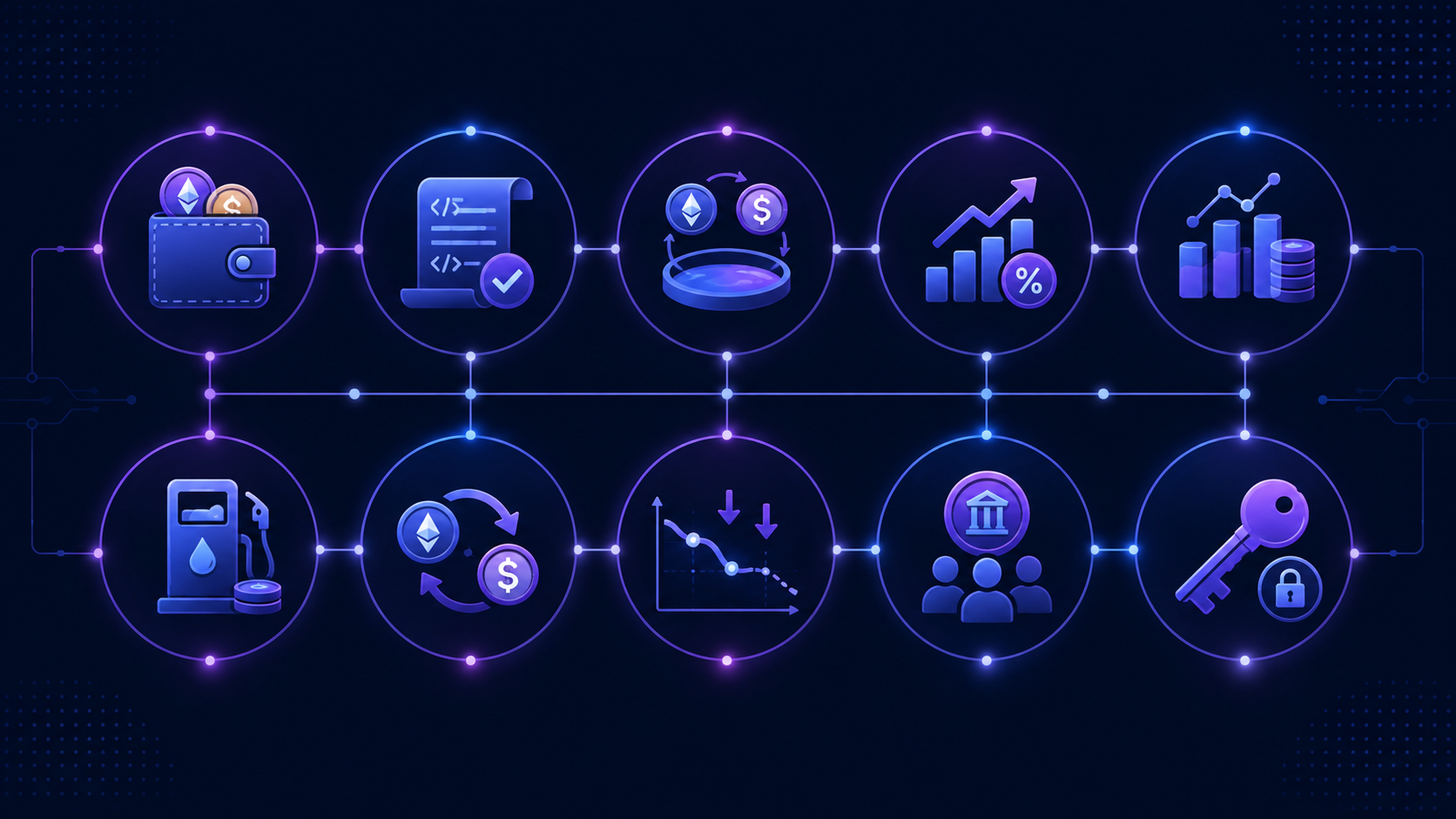
Here’s a quick reference of how they connect in practice: you connect your wallet secured by your private key to a DEX, where you swap tokens using a liquidity pool — paying a gas fee for the transaction. The pool is funded by liquidity providers earning APY on their deposits. The protocol’s total deposits are measured as TVL. Your swap affects the price through slippage. The protocol is governed by holders of its governance token, all of it running on smart contracts that execute automatically with no intermediary.
That’s DeFi in one paragraph — and now you have the vocabulary to go deeper into any part of it.
Educational content only — not investment, financial, tax, or legal advice. Cryptocurrency and DeFi involve substantial risk, including the potential for total loss of capital. See our full Terms & Conditions and Privacy Policy.